Archives for category: biographies

FERNANDO GONZALEZ- SIOCO

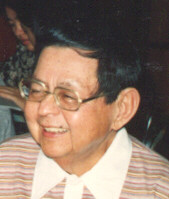
Dr. Fernando Gonzalez

Fernando was the eldest of the ten sons of the Dr. Joaquin Gonzalez and Florencia Sioco.  He was  the first of 5 doctors, 3 of whom are doctors of medicine (Fernando, Jesus, and Virgilio), one doctor of Science (Bienvenido) and the youngest (Fausto) doctor of Laws, from the University of Madrid.

“GENIUS IN THE FAMILY”

According to his brother Augusto, Fernando was the “genius in the family”. He excelled in the languages: German, which he did a self study in order to pursue his stamp and coin collections ) French, Spanish, English, Tagalog and even Sanskrit. -He was so proficient in these languages that he was able to write stories and plays in these languages. His wife Clementina had a musical family, and they enacted these musicales in public in San Luis. Teodoro M. Kalaw, National Library Director, met Fernando’s daughter, Eglantine, in 1933. He told her, “I knew your grandfather – Joaquin. He was a brilliant man. I knew too your father, Fernando. He was a brilliant man, too.” And the rejoiner of the daughter was not less flattering.

ARTIST,  PHILOLOGIST AND A TEACHER

Fernando was like his father, Joaquin, when the latter was young.  He was quiet and liked to do things with his hands.  One time, his aunt Soledad (sister of Joaquin) tried to help Fernando in making some art work.  She wound up messing up the job. Fernando cried and ran to his father.  Joaquin, amused that his son would be better than his sister, pretended to castigate him.  But after Fernando was out of hearing distance, he told his sister, “You should be ashamed that this eight-year old boy can do better work than you.”

Fernando’s love for the arts was so profound that he thought of becoming a philologist and a teacher, excelling in the languages.  At that time, and even to this date, these professions were not sufficient to support a family.  So his father discouraged him. Jokingly, Joaquin told him, “If you do this, you would need to wear a wide band of cloth on your forehead and hang a bolo or scythe at your waist, then be a thief, ready to rob people to support your family”. So Fernando took up medicine instead.

As a student, Fernando was easy-going. He didn’t need to study hard to get good grades. He didn’t buy his books. His classmates supplied him or lent him their books so Fernando could be able to participate in their classroom discussions. If, by chance, he did not attend class to visit to his lady love, the woman he married later, the whole class also preferred to boycott their class rather than be called to carry on the discussion of the day without Fernando.

HIS COURTSHIP OF HIS WIFE, CLEMENTINA

Fernando, being the eldest in the marriage of high profile parents, Dr. Joaquin Gonzalez and Florencia Sioco, had the pick of the eligible rich and “de buena familias” of the whole of Pampanga.  He often told his daughter, Eglantine,

“I could have married any of  the richest and most beautiful women in Pampanga during my time.  But I chose your mother for her simplicity.  I found the other women very spoiled and not to my liking.”

He met Clementina while Fernando was a medical student and  she went to Azcarraga (now Claro M. Recto Avenue) in Manila, to work as a Teacher.  Although Clementina herself owned several haciendas in San Luis, Pampanga, they were subject to floods, drought, and pests.  Her father sent her and her two siblings to work as teachers in Manila. Fernando visited her almost daily,  accompanied by one of his friends. Clementina thought he was interested in her more vivacious sister, Josefa, so she prayed to St. Anthony to give her a sign if he was at all interested in her.  At the deadline that Tinang gave to St. Anthony, Fernando slipped into her lesson plan a love letter.

They married on the day of the fiesta of San Luis.  Late on the night of June 21,m 1910, Fernando arrived with his mother Doña Florencia Sioco de Gonzalez and his brother Augusto, ostensibly to attend the town fiesta. They passed the night at the Elizalde house, but at 4:00 o’clock in the morning of the 22nd, Fernando and Clementina, dressed in their finest, were married at the main altar of the parish church.  After a simple breakfast reception, the couple left for Manila for a seven-day honeymoon.[1]


[1] Eglantine J. Gonzalez-Franco, Doña Clementina Elizalde-Gonzalez:  A Tribute.  Quezon City, Philippines, p.7.
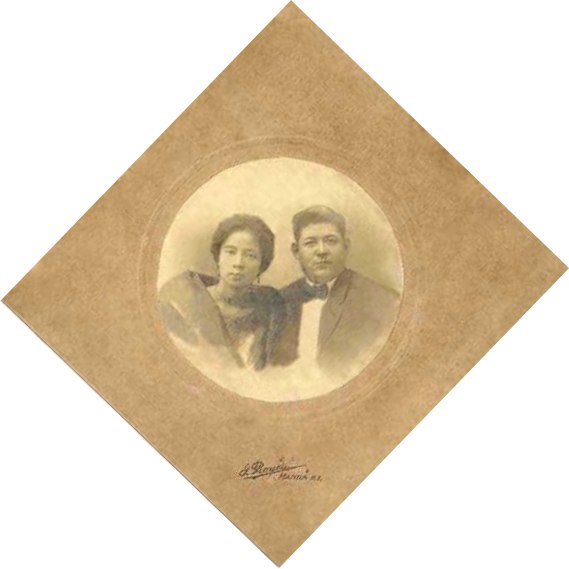
Clementina and Fernando

“DOCTOR PROVINCIAL”

In a Provincial Hospital

Fernando went on to become “Doctor of the Provincial.” He was stationed in La Union and Rizal. As a sanitary health officer, he enforced strict health rules. He forbade women to wash clothes in artesian wells. His men had to wear uniforms at all times. Meat sold in markets had to be checked. It was necessary to be strict at that time, since typhoid and other communicable intestinal diseases were widespread and caused a lot of deaths everywhere.

In his own house, Fernando disliked fermented food that was so popular in Pampanga. He forbade his family to serve buro (fermented shrimps in rice) and  balo-balo (fermented fish in rice) whenever he was around.

Before he retired, he accepted an assignment in Manila, so he could be promoted. This was where death found him.

COMMANDING PERSONALITY

Fernando sported well shaped whiskers which added a aura of formality and strictness to his personality . His son-in-law, Dr. Luis B. Franco, always joked that he was intimidated by the movement of the whiskers of Fernando, which indicated his displeasure. So Luis always kept away from Fernando’s sight, making friends with his future wife Eglantine’s brother, Amaury, as a pretext to see Eglantine.
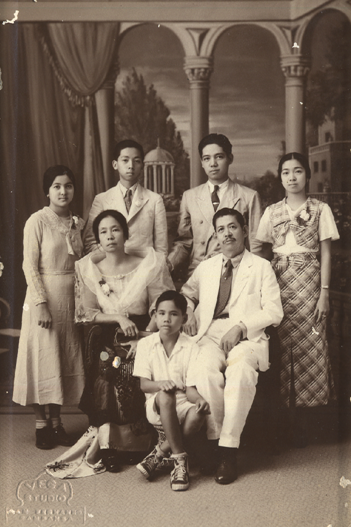
Fernando and Family 1935

Fernando also had a booming voice, which was characteristic of those who lived in huge houses.  However, his sawali house in San Luis was not as big as his mother’s bahay na bato in Apalit.  Aviong Ramirez recalled that they could hear his Tio Dando’s voice several houses away from where they lived.  Fernando would be heard calling their cook, “Marciana! Marciana!”  many times during the day.  And the whole community who  heard these calls, wondered what he would need from Marciana that he would need to call her many times during the day.

Lo cortez no quita lo valiente

Fernando was courtesy personified, a gentleman. He was fond of saying: “Lo cortez no quita lo valiente” Courtesy will not make you less a man. His daughter, Eglantine, remembers that, “as a young girl of 18 to 21 years, he showed me the utmost courtesy. I felt like a lady of consequence, with him leading the way to theaters, allowing me to go before him through doors when entering rooms, or assisting me in going up or down calesas or cars, always behaving the perfect gentleman that he was.”

To his family, Fernando was a loving family man and a pillar of strength to his very much dependent family.  He combined discipline and love and tried to impart to his children the values a father would like to give to his children, particularly regarding  money, humility, and family honor.

His eldest daughter Eglantine remembers this of her father: “He was strict in the way he let me handle my allowance – always with an accounting until the next one was given. He said it was a part of my education — the knowledge to handle money.” Such was the discipline Fernando imparted to Eglantine regarding money, that she became a successful business woman.

Eglantine also adds, “Humility was a virtue he exacted of me. Being the only girl in a big family of boys, I had the tendency to make capricho as my father termed it. He told me “No matter how beautiful, or how rich a girl is, she is nothing to me if she is spoiled – caprichosa. I had the best chance to marry the most beautiful, the richest and the most intelligent girls not only in Pampanga but in Manila and other provinces as well. They were nothing to me since they were spoiled girls. Instead I chose your mother who is simple, sweet and unspoiled, not the exigent or demanding type.”

FREE MASON

Fernando was recruited by Pepe Escaler to become a Free Mason when he was already an adult.  However, his wife, Clementina continued to be a Catholic.  He admonished the children to continue in the religion of their mother until they were 21 years old. When Catholic schools opened in San Fernando where he was assigned, he let the children study in them.

NATIONALISTIC

Fernando was ultra nationalistic preferring to be” ruled like hell by Filipinos rather than ruled like heaven by Americans.” (President Manuel Quezon had this same philosophy.) At one point in his life, he wanted to go into politics, but was dissuaded by his family.  However, after his retirement from the Bureau of Health, he decided to serve the country as a councilor of San Luis without pay. He could have ran for mayor but preferred not to.  He won easily, garnering more votes than the popular mayor who was re-elected. His being an idealist was, after all,  not lost to the town people who saw sincerity and simplicity on a son of a proud family– the Gonzalez of Apalit. In fact, the people from Apalit who knew the Gonzalezes as prominent and belonging to the upper class strata of society,  were surprised that even the small people loved Fernando to give him their votes.

Fernando’s political view at that time was “Anti-Independencia”. When his view ran counter to his brother Fausto’s “Pro-Independencia”,  Fernando withdrew into the background.  His wife Tinang became the campaign manager of Fausto in San Luis.

COMMON TOUCH

Fernando really had the “common touch”.  His tenants, the few who are still alive, in San Simon, Pampanga, regale stories to this day, remembering Fernando as someone who was “one of us”. During harvest time, he would visit the tenants and be with them during the duration of this period.  Naturally, mealtimes would descend on everybody, and Fernando thought nothing of eating in their homes, using his hands to eat, same as did the tenants. The tenants would set aside his share of the harvest, and Fernando, in a show of benevolence and generosity, would take a bundle of the rice harvest and give it to anyone he favored, to show his appreciation of their hard work. The camaraderie of tenant and landlord was strong between Fernando and his tenants.

As Doctor Provincial, he found himself with the people a lot. When the people offered him their “native delicacies”, such as  adobong iguanas, or snakes, he swallowed his revulsion of what was being offered to him, and accepted gracefully, even to the extent of pretending to like what was being offered to him. This was part of his courtesy, and polite demeanor.

THE PLEBEIAN GONZALEZ

Even if Augusto called Fernando “the genius in the family, he also called Fernando, “the dreamer.” While Augusto and Fausto went into high profile with their success in business and politics, they were a bit disappointed that their elder brother did not use his genius to create more money.

Augusto and Fausto laughed at Dando’s (Fernando’s nickname)  way of living.  While they (Augusto and Fausto) wore the latest fashions, drove the most expensive cars, Dando wore a camiseta and calconsillo,  drove a rickety car, a vintage Ford which often broke down.  Many times, Dando would be seen in the streets of San Luis, pushing his car with the aid of his maids and children, so it would start.

When Dando would go to Manila, he would take a truck.  His brothers would tease him,

            “Ayan ne y Dando, maca “Marcelo Diaz” ne naman!”

Marcelo Diaz owned the only truck from San Luis that went all the way to Manila.  Dando would use this truck to go to Manila when he went to visit his brothers.  “Marcelo Diaz” was a pun on “Mercedes Benz”.  Instead of riding a Mercedes Benz, Dando rode a “Marcelo Diaz” truck.

Even Fernando’s daughter, Eglantine was disappointed in her father.

“What?  A Doctor Provincial? Living in a house made of sawali?”

All the years that they were stationed in different parts of  Luzon, Eglantine accepted that they would live in rented houses. But when her father retired, she was expecting to live in a more comfortable house, maybe not unlike his mother Doña Florencia’s bahay na bato. So she was very disappointed that her father, whom she worshiped, the “Doctor Provincial of many hospitals, and respected by all, would return to live in San Luis, build his house in a lot inherited by his wife, Clementina, and made from sawali, or thatched bamboo, at that!  Eglantine swore that she would do better than her father, when the time came. And she did.

It was recently revealed to this author that the reason Fernando liked the sawali was because the air flowed easily through the house through the holes between the bamboo weaves. After Fernando died, the sawali was replaced by wood.

“DELCO”  GENERATOR

The only concession that revealed the truth that Fernando came from the wealthy Gonzalez family was his ownership of a “Delco” generator.  It was made of wet cells, and lighted up the chandelier in their living room and enabled them to listen to their classical music via their gramophone.  They were the only ones in the whole town who had a generator.  Before dusk, Fernando would gather his houseboys, and together they would start the generator, filling the whole town with its start-up noise. For lights, they had the “Aladdin” lamps.

SEARS AND ROEBUCK

One of the fond memories of the nieces and nephews of Clementina of  their Uncle Tio Dando were the gifts they received from him every Christmas.  A few weeks before Christmas, Fernando’s  order of  candies and toys from the  Sears and Roebuck would arrive.  These memories have stayed with Sofie Elizalde and Aviong Ramirez to this date.  They could not imagine how Fernando would painstakingly take the children’s characters and order presents that suited them perfectly, from the United States of America, at that! The Sears and Roebuck was also the source of the characters of the dioramas that Fernando fashioned for his children. He made dioramas depicting scenes of rural life, or war, and daily life.

 “UPHOLD THE FAMILY NAME”

Fernando had a strong obsession in upholding the honor of the family name. At that time, the Gonzalezes of Apalit had carved a niche for themselves in society.  Their father, Joaquin, was one of those who drafted the Malolos Constitution.  Fernando’s brothers, Augusto and Fausto, were well-known in the field of commerce and politics, respectively. Augusto had become a millionaire and married an Arnedo, the daughter of the political kingpin of Apalit, Macario Arnedo. Fausto, their youngest brother, was in the political limelight as a  congressman. However,  Fausto was still continuing with his naughty behavior which he had even when he was small. On his deathbed, Fernando called these two brothers and admonished them to be careful and keep the family name unsullied and untarnished.  These were his last words as he lapsed into unconsciousness, and died after two days.

This was Fernando. He never made money but he gave a shining example of honesty and integrity and an unselfish unblemished public service. This was Dando, happy in his camiseta and calconsillo, happily pushing his old Ford, composing plays and operettas, working for the poor.  The Plebeian Gonzalez.

FAUSTO AND AUGUSTO HELP THE FAMILY OF FERNANDO

Fernando died in one of the many properties of Augusto, in Malate, Manila.  After he died, Tinang (Fernando’s wife) asked Augusto if she could have the property for sentimental reasons.  Augusto gladly gave it to her, on condition that she pay off the amortization.  When Fausto heard this, he also offered to Clementina, another property that he was paying mortgage on. This was in Paco.    These two properties were eventually paid in full by Clementina, and these  helped her have a better life with the rental income until her death in 1991, at 110 years old.

Even in death, the brothers continued their guardianship of each other. Such was their love for one another.

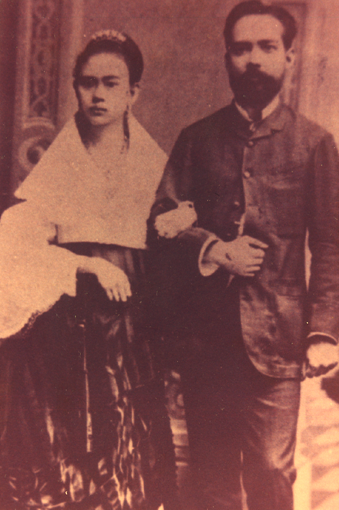
Wedding Picture of Florencia and Joaquin

Florencia Sioco was the daughter of Josef Sioco of Bocaue, Bulacan and Matea Rodriguez of Bacolor, Pampanga.  She was  24 years old when she married Dr. Joaquin Gonzalez, a son of a Spanish friar and Mariquita Gonzalez, of Baliwag, Bulacan.  After their marriage, the couple settled in Barrio Sulipan, Apalit, where he ran a clinic.  She and Joaquin had ten sons within thirteen years after their marriage. Her husband was engrossed in his medical profession. He became a delegate of the Constitutional Convention in Malolos.  Then he became a member of Aguinaldo’s cabinet. Then he was appointed as President of the Universided Sciencia, Literaria y Cultura. Then the Americans came, and Dr. Gonzalez was appointed to become chairman of a three-man civil service board with two Americans as members.  Before he could assume office, Dr. Gonzalez died suddenly of acute appendicitis in September 21, 1900, at the age of 47.

DELEGATING AUTHORITY

Any ordinary woman would have been fazed by all these things happening around her, like a whirlpool. But Florencia took tight rein on her household.  Her son, Bienvenido, told his daughter, Eva, that his mother was “quite strict”. She had to do this to maintain order in their large family.   Florencia told the older brothers to help take care of the younger ones.   When Bienvenido (Bindo) went to Los Baños to study, Florencia designated, Augusto, the fourth brother whom everyone called Titong, to be his guardian.  This relationship between  Bindo and Titong lasted until Titong’s death in 1939.  Eva remembers her father’s making a special trip from Los Baños to Apalit to seek Titong’s counsel before accepting the presidency of the University of the Philippines.   He would have continued seeking Titong’s counsel had Titong not lost his life to the Timbol brothers.[1[1]]

When Bindo’s second-to-the-youngest brother, Joaquin Jorge, decided to take up agriculture, Bienvenido was made his guardian. This way, Bindo repeated the relationship he had with Titong, this time, be being the guardian.

She was lucky to have enough resources to hire three mayordomas to manage her staff of 20. Mayordomas have management authority.  One mayordoma was to run her kitchen. Another to oversee the children’s clothes and needs. And a third one  to take care of the house.

ALONE WITH THE CHILDREN IN THEIR TEENS

Florencia was alone when her sons hit their teenage years. The Gonzalez boys were not spared the experience of  sexually being active when their  hormones were at their peak.  There are the some stories about Florencia calling a child, but the child cannot come right away, because he is in the middle of having sex with –.  But these stories are better kept unwritten.

FLORENCIA AND HER DAUGHTERS-IN-LAW

It was a relief for her to have her sons marry well. There was an initial objection to her son Augusto marrying his first cousin, Marina Escaler, daughter of Florencia’s sister, Sabina.  That was not allowed by law.  But Augusto and Marina still went through with  a quiet marriage held in Apalit Church  at 4:00 a.m.  The wedding of Augusto and Marina took place on May 21, 1909.  In deference to his brother, Fernando also did the same when he married Clementina the next year,  June 22, 1910.  In her book about her mother, Eglantine recounts,

Late on the night of June 21, Fernando arrived with his mother Doña Florencia Sioco de Gonzalez, and his brother, Augusto, ostensibly to attend the town fiest of San Luis.  They passed the night at the Elizalde house, but at 4:00 o’clock in the morning of the 22nd, Fernando and Clementina, dressed in their finest, were married at the main altar of the parish church.  After a breakfast reception, the couple left for Manila for a seven-day honeymoon.  Years later, a nosey barber asked my father (Fernando) if he and my mother eloped.  It was unthingkable that two prominent families could contract marriage without the townspeople being aware of it.[2]

Within twelve years, eight brothers had gotten married — Jesus and Isidora (1912), Javier and Josefa (1914), Emilio and Rosario Valdez (1916),  Bienvenido and Conchita Rafols (1917), Virgilio and Rosario Chong-Singson (1919), and Joaquin and Julia (1921).

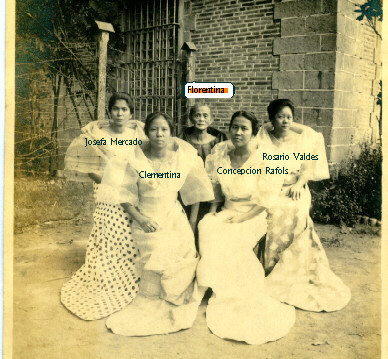
Florencia and her daughters-in-law

Pictured above are, from left to right, Josefa Mercado, wife of Javier; Clementina Elizalde, wife of Fernando; Conchita Rafols, wife of Bienvenido;  and Rosario Valdez, wife of Emilio.

Florencia held Sunday lunches in her house for her children and their families. She felt  a new wave of happiness.   She kept her children and grandchildren close to her at all times.  Eglantine, the second daughter of Fernando, was born in a bed in the house of Florencia.  This bed is now an antique carved over a hundred years ago by a Chinese bed maker.  Before Florencia’s house  in Sulipan was burned,  the bed was given to Clementina. It now stands in Clementina’s and Fernando’s ancestral home in San Luis, Pampanga.

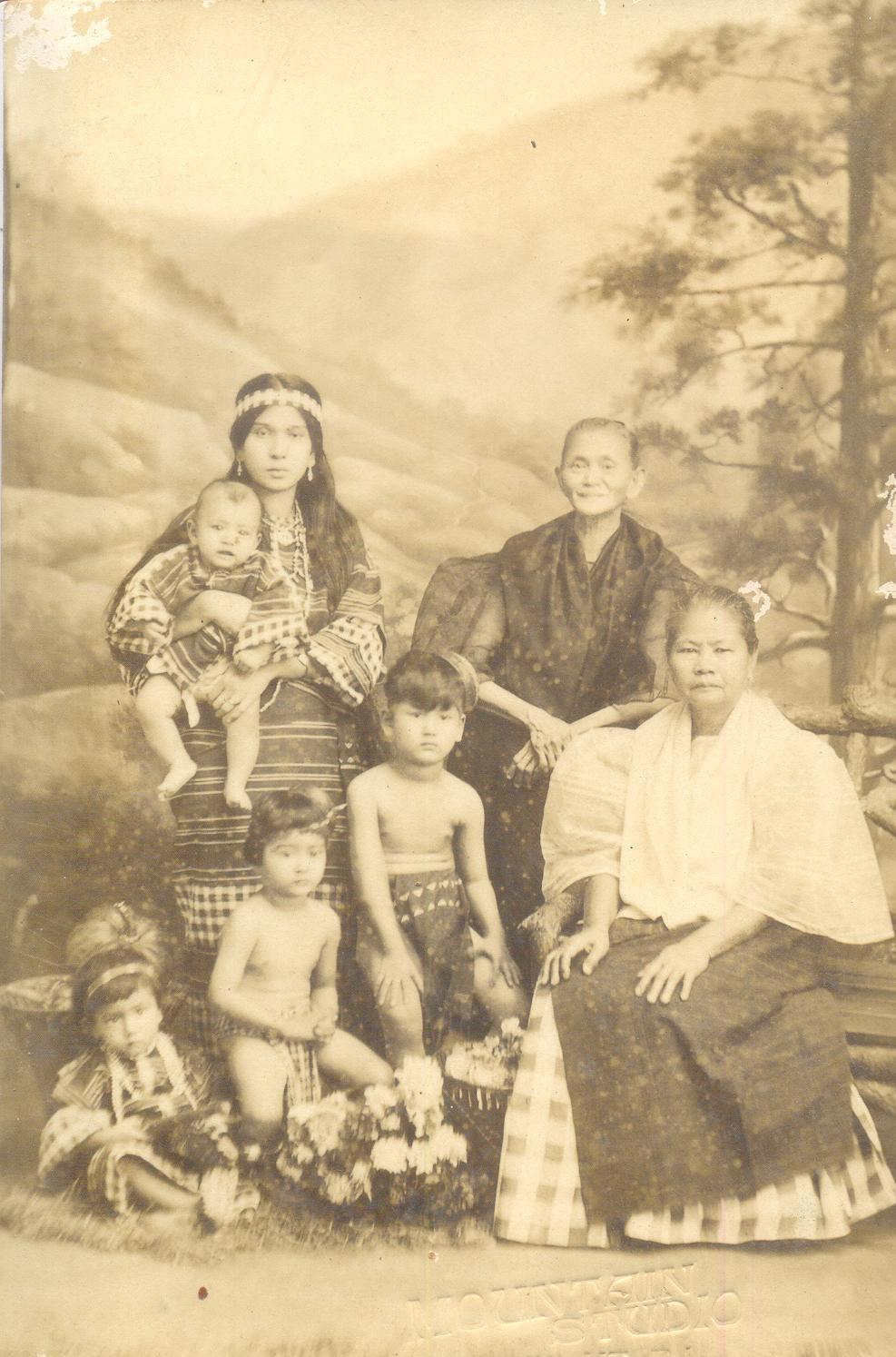
Florencia with a daughter-in-law and her grandchildren

HAVING FUN IN BAGUIO WITH GRANDCHILDREN

I will need an older generation to decipher who these people in the picture are with Florencia. Iit was the custom, then, that if you went to Baguio, you would go to a photographer to have a souvenir picture. You would be given costumes to wear.  Then you would give this picture to your relatives, for their files.  This was one such picture in my grandmother, Clementina’s, files.  I could only guess it was either Josefa Mercado and her children who were there, or Rosario Valdez and her children. It doesn’t look like Josefa Mercado because Josefa had thick hair.  But you can see the smile in Florencia’s face. She was enjoying being with her family.

Florencia died in November 6, 1925.   She was 65. She led a happy, complete, life..


[1]  Eva Gonzalez, on her write up of her memories of her father, UP Sixth President Bienvenido Gonzalez.

[2] Eglantine j. Gonzalez-Franco, Doña Clementina Elizalde-Gonzalez: A Tribute”. P.7.

            Mariquita bore six (6)  children with Friar Lopez.  They were three girls and three boys.

Soledad, the eldest child, bore a striking resemblance to her father.  Her childhood years were spent happily playing with her friends in the “convento” of the Baliuag Church and in the huge Gonzalez house.  She grew up to be a beautiful lady and she married Mariano Gonzales, a wealthy but deeply religious man.  She had seven (7) children:  Adelaida, Carlos, Caridad, Ceferino, Milagros,  Leon and Jacinto.

Jose, the second child, inherited the strong character of his mother.  He knew who he was and he did not allow anyone to forget it.  His favorite pastime as a child was to ride a gallopping horse inside the “convento” to the great consternation of the servants.  In his adulthood, he was used to undermining the Spanish curate and the military authorities.  He was notorious for his fiery temperament.  He married Francisca Carrillo, the daughter of another Friar, Father Arreola, and had six (6) children by her.  They were Ana, Maria, Filiberto, Carmelita, Luis, and Jose.

Joaquin, the third child, was a quiet boy who loved to read, play with animals, and make unusual toys.  He went to Spain where he became a doctor.  Upon his return home, he became involved in the struggle for independence.  He became a member of the Malolos Congress.  He married Florencia Sioco, and they had ten children:  Fernando, Jesus, Emilio, Augusto, Octavio, Virgilio, Javier, Bienvenido, Joaquin, and Fausto.  He settled in Sulipan, Apalit, Pampanga.

Rita, the fourth child, married a Spaniard, Jose Llora, and they had two children:  Ramon and Araceli.  They went to live in Spain.

Carmen, the fifth child, also bore a strong resemblance to her father.  She remained single.

Francisco, the sixth child, was a gregarious and playful little boy.  In his adolescence, like all boys, he became very fond of girls.  He married Maria Lloret, the daughter of a ship captain, when she was just 14 years old.  They had seven (7) children:  Ricardo, Paula, Estela, Sara, Cesar, Rafael, and Francisco.

Source:  This came from the earlier version of  the Family Tree Book  contributed by Renan Prado, Lita Estrada, Lilia Gonzalez, Tina Lesaca, Nena Franco.

I will write down all the dates of births, deaths and marriage for the Gonzalez Brothers and their Spouses.

Birth Death Marriage Age Married Age Died
7/22/1853 Dr. Joaquin
11/17/1860 Florencia Sioco
11/14/1881 Clementina
6/22/1884 Dr. Joaquin and Florencia J (31), F (24)
11/6/1884 Fernando
9/25/1885 Jesus Lope
9/27/1886 Emilio
1/2/1887 Isidora
11/8/1887 Augusto
2/23/1889 Octavio
7/18/1889 Marina Escaler
7/30/1890 Virgilio Rufino
12/1/1891  Javier Francisco
7/13/1892 Conchita Rafols
10/30/1893 Rosario Valdez
x/x/189x(3) Josefa Mercado Espiritu
3/22/1893 Bienvenido
4/23/1895 Joaquin Jorge
4/12/1896 Julia
5/30/1897 Fausto Felix
8/24/1899 Octavio 10
2/7/1899 Rosario Singson Veloso
9/21/1900 Dr. Joaquin 47
12/13/1903 Rosario Arnedo
5/10/1908 Luz
5/21/1909 Augusto n Marina A (21), M (19)
6/22/1910 Fernando n Clementina F (25), C (28)
3/12/1912 Jesus n Isidora (J (26), I (25)
10/18/1914 Javier n Josefa J (22) J (20)
3/21/1915 Pastora
10/8/1916 Emilio n Rosario E (30) R (23)
1/1/1917 Bienvenido n Conchita B (23) C (24)
5/1/1919 Virgilio n Rosario V (28), R (20)
11/5/1921 Joaquin and Julia J (26) J (25)
11/22/1922 Emilio 39
11/6/1925 Florencia Sioco 65
11/14/1926 Fausto n Amparo F (29) A (xx)
4/14/1928 Marina Escaler 38
2/20/1929 Virgilio Rufino 63
6/17/1929  Javier 37
8/15/1929 Amparo dela Rama 30
2/22/1930 Augusto n Rosario A (43), R (26)
4/7/1931 Josefa Mercado Espiritu approx 38
2/19/1937 Fernando 52
7/12/1939 Augusto 51
9/23/1941 Jesus Lope 55
9/15/1942 Fasuto n Pastora F (45) P (27)
5/14/1946 Julia 50
9/27/1947 Joaquin n Luz J (52) L (39)
10/15/1951 Fausto Felix 64
12/30/1953 Bienvenido 60
5/24/1964 Conchita Rafols 71
8/25/1968 Joaquin Jorge 73
3/29/1975 Isidora Espiritu 88
5/18/1977 Rosario Arnedo 73
6/9/1988 Luz 80
6/20/1991 Clementina 110
approx  2003 Pastora approx 88

The Brothers when they were Young

            THE GONZALEZ BROTHERS:  Their Life in Apalit

There are no stories on file regarding the romance of Dr. Joaquin and Florencia Sioco.  But looking at the record of their marriage, they registered their marriage on June 22, 1884, five months before their eldest son, Fernando, was born. Then every year,  one after another,  came Jesus, Emilio and Augusto.  The four children were well-behaved, and people branded them “apat  a matua”, meaning  “four matured/elder ones”. “Matua” connotes a feeling of respect.  “Balamu matua ya” means “ he acts matured beyond his years.”  When it is imminent that a baby is on the way, parents instill in their  elder children the responsibility of caring for this baby.    Of course, there can only be one “eldest child”. But in this family, the “apat a matua” were more subdued in comparison with the next batch.

Octavio came in 1889, but he was sickly and died after ten years.  He didn’t count.

After  a two-year hiatus, the next three children came in succession again. Virgilio came in 1890 quickly followed by Javier (1891) and then Bienvenido (1893). They were such a handful, they were labeled, “atlung demonius” – three devils.  This is always the fate of “middle children”.  The mother is already washed out from taking care of a big family, she doesn’t have time nor energy to give admonitions to the middle children as she did with the elder children.

In two years (1885), Joaquin II was born. Then another two years (1887), came Fausto.  These two were called “aduang bunso” or  the two youngest ones. They probably were overwhelmed by the ruckus caused by the “atlung demonius” they didn’t have the heart to add more problems  to their mother and their elders.

These were just labels to distinguish the grouping between the children.  We all know that children go through phases. When the “aduang bunsu” went into the teen phase, they did things as naughty as the earlier batch.

One such story was about Fausto, the youngest child.   During one baile, or party with dancing, he brought a pair of horses to the sala (living room). One of the horses was dressed in a frocked coat and wearing a hat, and the other one was dressed in a “Maria Clara”, meaning woman’s gown.  The guests were all shocked, but since this was a party, the shock turned into laughter.   The guests were all probably used to Fausto’s “cute” antics.

Between Fernando and Fausto, a period of thirteen (13) years, Florencia produced ten (10) children, all sons!

RUNNING THE APALIT HOUSE

Can you imagine the logistics of running a house with ten children? “Imang” Bets Rodriguez[1] remembers that the Gonzalez house was staffed with around twenty (20) maids.  Out of these, three (3) were mayordomas, three cooks, and four (4) men who did the gardening and cleaning of the cars.  They also had “balugas[2] who, at that time,  were not considered intelligent.

Florencia, the mother, supervised the kitchen very closely.  She would go to nearby Calumpit market, Bulacan, and buy everything in sacks.

VEHICLES

The family owned six (6) cars, several caruajes, some tiburins or Victorias, A Buick, and some calesins.  They were all parked in the garage.

THE APALIT HOUSE

The house of Florencia and Dr. Joaquin Gonzalez was built in 1883.  It was built in the floral style of the late nineteenth century, with a tile roof, tall windows with glass panes (instead of capiz used in the older houses), and a brick-decorated base.  Inside, curved arches in the Art Noveau style defined the different areas of the house.  Red bamboo lacquered panel walls provided an interesting touch.[3] It also had an entre suelo to provide more rooms for its inhabitants.

The house was bombed in 1945 by the Americans. They thought that the Japanese were hiding there.   It was part of the carpet bombing operation to weed out the Japanese from hiding.  There are no pictures of the Gonzalez Apalit house on account of the bombing.

HOUSE OF DIPLOMAS

Everyone who went to visit the Gonzalezes always noted  the Diplomas that were hanged prominently in the living room walls.  All the Gonzalez boys went to college and received diplomas. There were three doctors – Fernando, Jesus, and Virgilio;  three agriculturists – Bienvenido, Augusto and Joaquin; one pharmacist – Emilio; two lawyers – Fausto and Javier.

FAVORITE FOOD OF THE BOYS

Like any youngster, the Gonzalez boys loved potato chips.   They would be  peeled and cut round and thin, then soaked in salted water.  Then they would be dried before being deep-fried.


[1] Miss Beatriz “Imang Betz” Rodriguez is the eldest surviving member of the Rodriguez Clan of Bacolor, Pampanga, from which the Gonzalez-Sioco family of Sulipan, Apalit, Pampanga, are descended. She is a half-first cousin of Florencia Sioco y Rodriguez, since “Imang Betz” father, Felix Rodriguez y Bautista of Bacolor, was a younger half-brother of florencia’s mother, Matea Rodriguez y Tuason. The prefix “Ima” is given to an older woman as a sign of respect.

[2] Aetas.

[3] The description of the Apalit house was provided by Augusto “Toto” Gonzalez III, based on his researches on the subject.

JOSEF SIOCO

Josef Sioco

Josef  Sioco was originally from Bocaue, Bulacan.   His first wife was a lady surnamed “Carlos”. They had a daughter, Maria de la Paz Sioco y Carlos (+1897).  Maria married Joaquin Arnedo Cruz y Tanjutco (+1897).  (These + signs signify years when they died.)

Josef remarried. His second wife was Matea Rodriguez y Tuasan (+191_).  Matea was the second daughter of Olegario Rodriguez (+1874) by his first wife Escolastica Tuason (+1850).

Josef and Matea had three daughters:  Francisca (born before 1858), Sabina (1858-1950) and Florencia (1860-1925). Francisca died young.  Sabina married her Rodriguez first cousin Manuel Escaler y Rodriguez, of Balanga, Bataan.  Florencia married Dr. Joaquin Gonzalez of Baliwag, Bulacan.

After Josef Sioco’s death in 1864, Matea Rodriguez viuda de Sioco married Juan Arnedo Cruz y Tanjutco, the rich brother-in-law of her stepdaughter, Maria de la Paz Sioco de Arnedo.  Matea also outlived Juan.[1]

One of the characteristics of Josef Sioco was that he was a very good businessman.  He was able to accumulate a many pieces of landholdings all over Bulacan and Pampanga.  They called Josef, “Pepeng Daga”, which implied that he was like a rat, having small pockets of lands everywhere he went.

Some said that his lands reached  Tarlac, but there was no evidence of this from the Project of Partition[2] executed by the Gonzalez Brothers when Dr. Joaquin Gonzalez died.  The lands that could only have come from the inheritance of  Doña Florencia from her father Josef  Sioco , were in Magalang, Sulipan (Apalit), Capalangan (Apalit), Sucad (Apalit), San Vicente (Apalit),  Portrero (Bacolor), Cabalantian (Bacolor), Nabong (Calumpit), Tulauc  (San Simon) and  Sta. Monica ( San Simon).   If you map out these lands, you can see that it stretches from Apalit to Bacolor to Magalang.

The list looks impressive at first glance, but when Augusto, the most successful brother, tried to distribute the lands to his siblings after the death of their father Dr. Joaquin Gonzalez, he had difficulty raising the total value that each child would get to P4,000. From the Project of Partition, Augusto reached the “Fifth Revision”, and each child could only get P3,175 each. Eventually, he was able to distribute P4,000 each.

Later, these lands were  augmented by  direct purchases of lands or marriage to an heiress by the Brothers.

When Doña Florencia died in November 6, 1925 in Apalit, Pampanga, a subsequent Project of Partition was undertaken and finalized in 1927.  Unfortunately, this  author only has the Supplementary of the Partition, not the Main document. There was no mention of lands other than the Baliwag and San Simon lands, the Baliwag lands having come from Dr. Joaquin’s inheritance from Mariquita Gonzalez.


[1] Augusto Gonzalez III.  “Proposed Day Trip of the Gonzalez Doble Zeta Core Group”.  April 14, 2004.

[2] En El Interesado Del Finado Don Joaquin Gonzalez, “Proyecto De Particion De Bienes”. Causa Civil no. 254, Gobierno de las Islas Filipinas, Jusgado de Primera Instancia de Pampanga, Septimo Distrito Judicial.  July 1, 1915. 17pp.

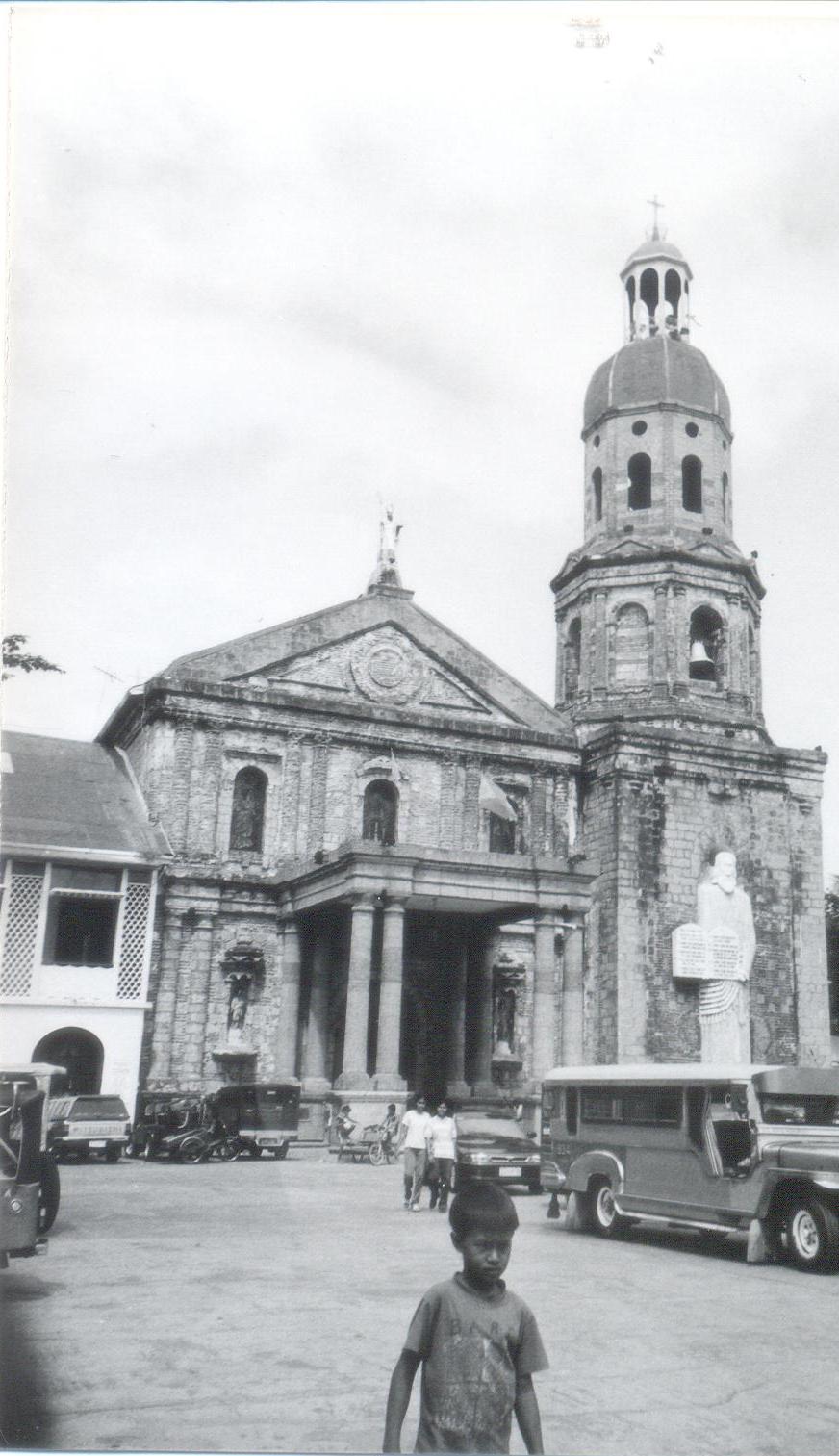
Baliwag Church

This is the Baliwag Church how it looks today.  This is where Friar Fausto Lopez conducted his duties as parish priest.  There are many very rich persons who originated (and some still live there)  from Baliwag, who, during Good Friday, try to outdo one other by putting up carriages with very elaborate and impressive depictions of the Passion of Christ.  The number of carriages that have joined the procession have reached over 150.  The cost of each carriage runs into millions of pesos.  The owners and their staff walk behind proudly behind their carriages to show that they “have arrived”, and also in thanksgiving to the graces they have received during the year.

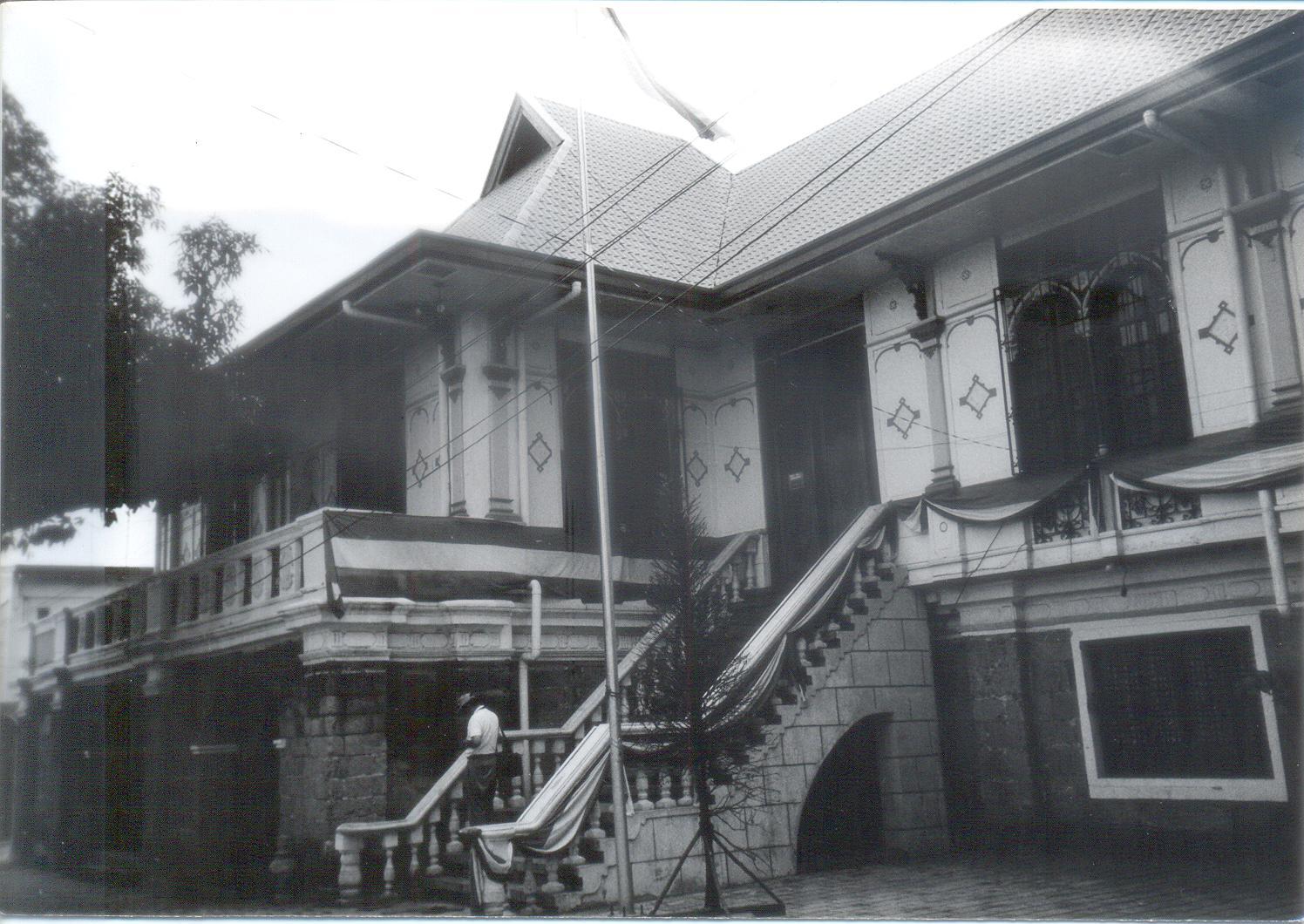
Ancestral House of Joaquin Gonzalez

This is the house of Jose, one of the children of Mariquita Gonzaelz.  According to the Department of Tourism Plaque that is posted on the ground floor, it belonged to “the family of  Dr. Joaquin Gonzalez”. When Dr. Joaquin left for Apalit,  the other sisters had their own houses. Normally, in Asia, the one who inherits the ancestral home is the Son.  So, by default, Jose Gonzalez, inherited this house.

The Plaque states, and I quote verbatim with my translation:–

SENTRO NG KASAYSAYAN AT KALINANGAN NG BALIWAG

(Summary)

Ang makasaysayang gusaling ito, na dating tahanan ng pamilya ni Dr. Joaquin Gonzalez, ay unang ginamit bilang Bahay Pamahalaan o municipiong Bayang Baliwag noong unang dekadang pananakop ng mga  Americano. Ito ay may sukat na 2,081 metro kwadrado.

This historical building, that was the former house of the family of Dr. Joaquin Gonzalez, was first used as the Municipal Hall of the town of Baliwag during the first decade of the American Occupation (of the Philippines).  The house measures  2,081 sq.m.

Malipas ng mga sampung taon, noong Setiembre 15,1915, binili ng pamahalaang local ang gusali kasama ang lote.

After ten years, in September 15, 1915, The house and lot was bought by the Local Government

Nagsilbing municipio ang lumang bahay na ito sa loob ng mahigit na animnapu at limang (65) taon.  Hanggang 1971, kung kalian pinasinayaan ang bagong municipio sa ilalim ng pangasiwaan ng noo’y Alkalde Florentino Vergel de Dios. Sa pakiusap ng Baliwag Historical Society sa pangunguna ni G. Rolando E. Villacorta, ang lumang bahay ay ay inukol bilang aklatan o museo.

This old house served as  the Municipal Building  of Baliwag  for a period of 65 years.  In 1971, a new Municipal Building was constructed under Mayor Florentino Vergel de Dios.  The Baliwag Historical Society, headed by Mr. Rolando E. Villacorta, proposed to the authoritities that the Gonzalez house be converted into a Library or Museum.

Noong 1993, ipinaayos at ipininanatili ang dating anyo ng gusaling ito sa pagsisikap ng dating Alkalde Carling Trinidad at sa malaking ambagna ginampanan ni Kinatawan Pedro Pancho.  Ang pagpapaayos ay isinagawa sa malaking tulong ng Dating Kalihim Mina T. Gabor ng Kagawaran ng Turismo at ang Philippine Tourism Authority.

In 1993, this Building was renovated under the efforts of Mayor Carling Trinidad and funded with a generous contribution from  Congressman Pedro Pancho  The renovation was done under the auspices of Tourism Secretary Mina T. Gabor and the Philippine Tourism Authority.

Pagkatapos, tinanggap ito muli ng Pamahalaang Bayan ng Baliwag, sa pamumuno ni Alkalde Rolando Salvador, sa isang pormal na seremonya na ginanap noong Agosto 9, 1998.

The Building was received again by the Government of Baliwag headed by Mayor Roldando Salvador, in a formal ceremony that took place in August 9, 1998.

Ang seremony pinangasiwaan ng Baliwag Tourism Council ay tinampukan ni Gng. Gemma Cruz-Araneta, Kalihim ng Kagawaran ng Turismo at Governador Josefina M. dela Cruz ng lalawagin ng Bulacan.

The ceremony, undertaken by the Baliwag Tourism Council, was graced by Mrs. Gemma Cruz-Araneta, Secretary of Tourism, and the Bulacan Governor Josefina M. dela Cruz.

-0-0-0-0-0-0-0-0-0-0-0-0-0-0-0-0-0-0-0-0-0-

Eva Iral, the representative of the Baliwag Gonzalezes still living in Baliwag, Bulacan, disputes that the statement of the DOT that the  house (above) used by the Americans during the American Occupation, was the ancestral house of Mariquita Gonzalez.  She says that this was really the house of Jose, the youngest of Mariquita’s children.  Eva even goes further to state that the house of Mariquita was positioned right across the Church.  This made it possible for an underground tunnel to connect the Church and the house, to provide a better access for the forbidden relationship of Mariquita and Friar Fausto, to flourish. Eva Iral died in 2010,  which makes us unable to confirm her statement.

Friar Fausto Lopez

The origins of the Gonzalez family date back to the Baliwag, Bulacan of the 1840’s. From 1733 to the end of the Spanish regine in 1898, Baliwag had about thirty curates. The two who had the longest years of service were Friar  Esteban Diaz Hidalgo who established a record of forty years, and Friar Fausto Lopez, who served a total of twenty-one years. However, it was Fausto Lopez who left the most lasting imprint in Baliwag, for during his lengthy stay, he was able to cultivate a completely human relationship with a local mestiza named Mariquita.

Fausto Lopez was born in 1811 in Valladolid, Spain, a descendant of Castillan nobility. He had a sister who was lady-in-waiting (a position only nobility could occupy) to the daughter of Ferdinand VII, Queen Isabel II who reigned in 1833. Fausto finished his reliegious studies in Valladolid in 1828. On October 3, 1829, after a long and tedious sea journey, Fausto set foot in the Philippines as an idealistic young priest of eighteen summers. His first assignment was in the island of Cebu, where he resided until 1837 as Amber Secretary of Province. In 1841, he was transferred to Quingua (now Plaridel), Bulacan, and promoted to Curate and Member of the Governing Committee. In 1845, he was re-assigned to Baliwag, Bulacan where he continued to function as the Curate and Member of the Governing Committee for twenty-one years. [1]
It was in Baliwag where the present Gonzalez lineage began. Fausto, then in his mid-thirties, met and fell for the charms of a local belle named Maria Amparo Gonzalez, fondly called Mariquita. Mariquita was the eldest of the many children of Vicente Gonzalez and Venancia de los Angeles. Vicente Gonzalez was of Quinqua (Plaridel) ancestry. Mariquita was beautiful, strong willed and deemed unconventional for her times. Ably mounted on her horse, she would survey their lands alone, engage in target practice with a rifle and direct her business affairs in stiff competition with her male peers. Her family owned the biggest house in town which occupied a while block. The house later on became the municipal building. The family was known for its strength of character and an astute business sense. It was no wonder then that Mariquita caught the interest of the influential cura, Friar. Fausto Lopez. Not uncommon in those days, a romantic relationship ensued and the union yielded six siblings: Soledad, Jose, Joaquin, Rita, Carmen and Francisco.

The disgrace casued by Friar Fausto and Mariquita led to the disuse of “Lopez” by the children, leading to the usage of “Gonzalez” instead.

Friar Fausto failed God, but God did not fail him.  God gave Padre Fausto and Mariquita, a son, Joqauin, who went on to be the pride of the “Gonzalez” clan.

Friar Fausto died on Sunday, April 17, 1865 at the age of 54.  He was buried in the San Agustin Church in Intramuros.  Unfortunately, his tomb was washed out during the Second World War.


[1] Source:  Elviro Jorde Perez. 1901. Catalogo Bio-Bibliographico de los Religiosos Agustinos de la Provincia del Santisimo Nombre de Jesus de las Islas Filipinas Desde su Fundacion hasta Nuestros Dias. Manila. Estab. Tipo. De Colegio de Santo Tomas.

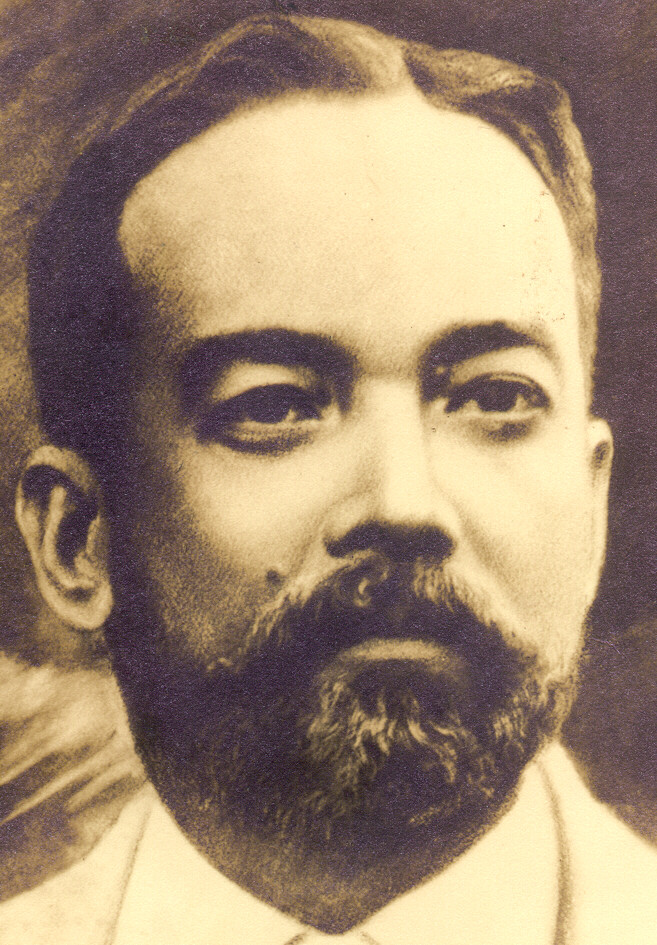
Dr. Joaquin Gonzalez

DR. JOAQUIN GONZALEZ-LOPEZ

(1853-1900)

One hundred and eleven years after his death,  historians are still finding things about Dr. Joaquin Gonzalez-Lopez.   According to a list of the first Filipino doctors of medicine and surgeons in the archives,  Dr. Joaquin Gonzalez Lopez was not only the first Filipino doctor of medicine, he was also an ophthalmic surgeon (1878) antedating the more famous  Jose Rizal who trained in the same Paris clinic of Dr. De Wecker.[1]   However,  since Dr. Joaquin was not a national hero,  this fact has not been given as much notice as it would have gotten if otherwise.

As far as Baliwag, Bulacan is concerned, Dr. Joaquin Gonzalez ranks next to Mariano Ponce as the second most illustrious revolutionary figure the town of Baliwag has ever produced. [2]

Belonging to the prominent Gonzalez family, Dr. Gonzalez engaged in a lucrative medical practice in town for quite some time, with his clinic located in their big ancestral home across the old Municipal Building along the National  Highway.  He used to give free treatment to indigent townmates.

Joaquin was born in Baliwag, Friday, July 22, 1853, the illegitimate son of an Agustinian friar who came to Quingua  (Plaridel) in 1841 and Mariquita Amparo Gonzalez, a native “mestiza” with a caustic temper.

Joaquin had his primary schooling in Baliwag.  After obtaining his AB degree from Colegio de San Juan de Letran, he sailed for Spain on March 1872.  He received his “licenciado en medicina” from the Universidad de Valladolid.  From the Universidad Central de Madrid, he received the MD degree in 1878.  After his graduation, he went to Paris where he became an assistant for a time in the laboratory of Dr. Louis Weckert.  Then he travelled  extensively in France, Germany, Switzerland, and Italy.

When Joaquin returned home, his mother Señora Mariquita did not recognize him at first.  The tall, bearded doctor arrived home in Baliwag at about eight o’clock one night and started knocking loudly on the door.

“Titang,” he repeatedly called in a low voice.  (Joaquin called his mother by that name.)

Señora Mariquita was roused from her retirement.  She could only hear the persistent rapping, not his voice.

“Who could be calling at this ungodly hour?” she demanded temperamentally.  Remember, she had a horrible temper.  She went to the housemaid to find out.

The maid came back and reported: “It’s a Spaniard,  Señora, a big bearded Spaniard.”

Señora Mariquita was perplexed.  She became more so when the strange looking caller familiarly addressed her “Titang” and hugged her.  It took her many seconds longer before she identified the once clean shaven face.

“Joaquin!” she shrieked.

“Titang!” responded Joaquin as he burst out laughing and kept kissing her.[3]

Joaquin first established a clinic at Plaza Binondo in Manila, but he later transferred it to his hometown.  His first patient in Baliwag was a man who had fallen from the lower section of the church belfry.

Florencia and Dr. Joaquin Gonzalez

At age 30, Joaquin married  Florencia Sioco y Rodriguez, the youngest daughter of Don Josef Sioco and Doña Matea Rodriguez .  They were married at 4:00 a.m. at dawn, Tuesday, January 22, 1884,  by Rev. Fr. Antonio Recondo ORSA,  with Jose Gonzalez, Joaquin’s brother , and Maria Sioco, Florencia’s aunt, as sponsors. At the beginning, Florencia’s mother, Matea Rodriguez, disapproved of the her daughter marrying Dr. Joaquin.   She did not like like Dr. Joaquin because of his Spanish mestizo penchant for “dulce vida” / good life.[4]  But Florencia could not be swayed by her mother’s wishes.

After their marriage,  Dr. Joaquin and Florencia moved to Apalit, the hometown of Florencia.

For a short term in 1896, Joaquin discharged the Office of Justice of the Peace of Apalit, Pampanga, where he had his permanent residence in Barrio Sulipan.

During the first period of the Revolution against Spain in 1896, he was appointed First Lieutenant of the Spanish Medical Corps of Volunteers.  He was awarded a medal of “Merito Civil” for this. During the second stage, in May 1898,  Joaquin was nominated as Member of the Consultative Assembly  by General Augustin, but that gesture failed to win back Filipino loyalty to Spain.

Joaquin was one of the two elected representatives of the Pampanga province (the other being Jose Rodriguez-Infante) to the Malolos Congress.  He was a member on the Commission on Credentials, and was one of the many nominees for Vice-Presidency on the first voting.  But the Body finally elected Benito Legarda, and Joaquin was named one of the members together with Felipe G. Calderon, of the Committee created to draft the Rules of Debate and Procedures of the Congress, and member of the Drafting Committee created to frame the constitution.

Joaquin had the distinction of being the First Rector of the Universidad Literaria de Filipinas (Cientifico was added later), the first Philippine State Unifersity.  General Emilio Aguinaldo, then President of the Revolutionary Government, founded this institution at Malolos as the highest seat of learning in the Philippines by his Decree of October 19,1898. Aguinaldo appointed Joaquin to the position upon recommendation of Felipe Buencamino Sr., who was at the time a member (Secretary of Promotion) of Aguinaldo’s cabinet.

The new university, succeeded in 1908 by the University of the Philippines (UP), was inaugurated on November 10, 1898, five months after the proclamation of Philippine Independence at Kawit, Cavite.  It offered courses in medicine and surgery, pharmacy, civil, canonical, administrative, and notarial law.

The outbreak of Fil-American hostilities, however, affected the University’s existence.  When Malolos fell to the American invading forces, Aguinaldo transferred the Philippine capital to San Fernando, Pampanga, and later to Tarlac where onSeptember 29, 1898, the school held its first commencement exercises under Dr. Leon Ma. Guerrero.  Guerrero, who is honored with a street name in Baliwag, was the second and last rector of the ill-fated university.

The faculty of the “Universidad Cientifico-Literaria de Filipinas”  included some prominent Filipino educators.  The following were some of the faculty, whose names have become well known in the history of the Philippines:

LAW faculty:  Cayetano S. Arellano, Pedro A Paterno, Arsenio Cruz-Herrera, Pablo Ocampo, Hipolito Magsalin, Tomas G. del Rosario, and Felipe G. Calderon:

MEDICINE AND SURGERY: Jose Luna

NOTARIAL  LAW faculty:  Aguedo Velarde, Arcadio del Rosario, and Juan Gabriel.

The General Secretary was Mariano Crisostomo y Lugo.

At the time of his appointment as Rector, Joaquin was serving as Member of Felipe G. Calderon’s committee created by the Malolos Congress to frame the Constitution.  Actually, he was one of the 16 physicians among the elite group of Congress members representing the “best constitutional minds of the country”.

Embodying the Filipino people’s cherished aspirations and political ideals”, the Malolos Constitution was adopted after two months of debate by the 92 member Congress and it was hailed as the “most outstanding legislative achievement of the First Philippine Republic”.

When the question of the unity of church and state came up for discussion in the Congress, Joaquin was one of the three who defended the adoption of the Roman Catholic religion as that of the State.  He wrote an article in support of that position.  He was succeeded as Rector of the University by Dr. Leon Ma. Guerrero.

After the establishment of US military government in the Islands, Joaquin was named Chairman of a three-man Civil Service Board with two Americans as members (Frank M. Higgins, chief examiner, and W. Leon Depperman, secretary). Unfortunately, however, Joaquin died of acute appendicitis on September 21, 1900 in Manila before he could assume his duties.  The vacancy was filled up by the appointment of Cayetano S. Arellano.

That a highly competent physician like Joaquin should die of appendicitis is rather puzzling.  Joaquin knew exactly what was going to happen to him.  In fact, when he heard a soldier’s trumpet blowing one late Thursday afternoon from the Spanish quarters across their house in Malate, he told some friends and relatives:  Tomorrow I’ll not hear that sound again.”  True enough, he never did, for he died the very next die.  Joaquin died at 6:00 in the morning, Friday, September 21, 1900. He was buried 12:00 noon, Sunday, September 23, 1900 at the Paco cemetery.  The cortege that followed his remains included Civil Governor William H. Taft.  A few years later, his remains were moved to the Apalit Church.


[1] Ambeth Ocampo, “An Earlier Eye Specialist Than Rizal.” Citing the findings of Dr. Luciano P.R. Santiago, a practicing psychiatrist who is also one of the country’s finest historians, when the latter unearthed the (list of) the first Filipino doctors of medicine and surgery (1878-1897) from the archives, Philippine Daily Inquirer,  June 23, 1999.

[2] Roland E. Villacorte, Baliwag: Then and Now,  Philippine Graphic Arts, Inc.  Caloocan City, 1970. Pp. 274-6.

[3] Rolando E. Villacorta, ibid., p.275. This incident was narrated by Atty. Ricardo Lloret, one of Dr. Gonzalez’ nephews.  Born on October 17, 1886, Lloret,  along with Alfonce Ponce Enrile, both were the most prominent legal luminaries of Baliwag. Lloret was elected to the Philippine Legislature in 1917. He had to wait a few days before taking his oath because he was under the legal age requirement for this post. He later became the Secretary of the House of Representatives.

[4] This was pointed out to me by Toto Gonzalez, in his own blog, “Remembrance of Things Awry”. Toto said that he heard this from Eglantine Franco, daughter of Dr. Fernando, the eldest son of Dr. Joaquin and Florencia.

QUINCHO GONZALEZ

Quinchio

Joaquin Julian Salgado Gonzalez, or “Quincho” was the eldest son of Joaquin Jorge Gonzalez and Julia Salgado. He was born on September 13, 1922 in San Fernando, Pampanga.

He married Beatriz Bisquerra Mejia, the first child of Fabian Mejia  and Rita Bisquerra of Abra.  Fabian graduated from the Philippine Military Academy and his first assignment was at Natunin, Mounain Province. New graduates of the PMA are usually given hardship posts.  Natunin was located in a very remote place, only reachable by horse.   Betty was born in Natunin.

Then Fabian Mejia was assigned to San Fernando, Pampanga. She went to school at the Pampanga High School. Quincho was living there, just at the back of the School.  That’s where he met Betty.  She didn’t like Quincho at first glance.

“E que buri kanita,” she said.

Then Betty went to become a college intern at the Philippine Women’s University.  Quicnho went to La Salle. He would park his car in front of PWU and wait for her.

When World War II broke out, Fabian Mejia brought his family to Mindanao and became a leader of those fighting the Japanese.  He ended up as the aide of the President Manuel L Quezon.  When Quezon took a submarine to Australia, he was one of those who saw him off.  Quezon promised that, when he returned, he would make Fabian Mejia an important member of his staff. But Quezon died in Australia.

At the time when it seemed that War was coming, Quincho fetched Betty from PWU and brought her home to the family house in Sta. Ana, Manila.  So she stayed with him and gave him seven  children.  During Liberation (1944), Jojo, the eldest son, was born.  Quincho took an apartment at Gastambide, Sampaloc. The children were then born one after another.  Since Quincho was close to the universities, he  decided to study  Commerce and later Law at the Far Eastern University.   By the time he graduated from his Law degree, he had already four children. All of the children went up the stage.  It was now 1949, the year  Jimmy was born.    Quincho almost topped the bar, but he never practiced law. At that time, he was already working at the Tours and World Service, a travel agency.

When Joven was born in 1950, Quincho’s luck exploded.  The family  called Joven their “lucky boy”.  Quincho was able to buy a house in Josefina, Sampaloc, where they lived until Jeffrey, the second to the youngest child,  was born.

The turning point in Quincho’s life was when he joined Eusebio Canilao who owned the Tourist World Service.  They became very close, so much so that  Seung (Eusebio) became the godfather of Joven in his baptism. Quincho also joined the CF Sharp Travel and Shipping owned by the Rocha family. Then he took his brothers Alfonso and the others and put up his own company, the International Travel Consultants (ITC).

In 1951-52, Quincho took a break. He went abroad for three months.  He lived in Spain. He wanted to see how the world was, outside the Philippines. He also wanted to know more about the countries where he was sending people to work.

Quincho  was very motivated. He personally serviced VIPs like the Alontos, Diosdado Macapagal, Ninoy Aquino. Alonto would take a whole block of an airplane when he went to Jeddah for his pilgrimage and other business.

Quincho became very successful in the travel agency business.  He got his brother Susing, who was then driving for a company, to work in the travel business. He got his sisters, Zeny and Dorita, then  his other brothers, Ponzo and Dado.  Susing and Zeny opened the Continental Tours—Susing, the Continental Tours in Makati, and Zeny the Continental Tours (Dewey Arms branch)  in Bayview Hotel which  later transferred to the Elke’s club.  Netting and Dado ran Air France, with Dado as the sales representative. Even Quincho’s  sons joined in the business.  Jojo became the KLM and the TWA manager.  Jesse from the States, took Cathay Pacific.  Butch was in Alitalia.  All of them arranged tours and brought the first Overseas Workers to Europe. It was a fun time for all of them, with the money coming in and with travelling first class and staying at the best hotels in Europe.

In 1968, Quincho was at the peak of his career.  He bought a house in Jupiter, Makati.  Then  the house in Forbes Park, Makati came along, and he bought  it.

He let his sons drive expensive cars.  Jojo remembers driving up to Baguio with his two younger brothers when he was just sixteen years old.  Of course, at that time, the driving was easy, and the sons were good drivers

Martial Law  was declared in September 21, 1972, and put an end to all of that. People could no longer travel at will. They either had a migrant visa or a study visa, for them to go abroad.   Quincho suffered a heart attack  in 1972 because the travel agents couldn’t collect money for tickets issued to their customers,  and  Quincho had to pay off the tickets which he had issued to the agents.  Their life changed overnight.

Since there was no more travel, Susing went to oversee the farm in Pandacaqui. Later, Dorita took over as Overseer.   Quincho, Betty and their children went to the States in  1976 to live there. Zeny and Alfonso  also followed suit.

At the beginning, Betty was just being seen by a doctor in the States.  She started getting episodes where she had to be hospitalized. Then in 1981, she was operated upon in Pasadena, California.  She stayed long in the hospital. In 1987, Betty passed away.

Betty  resisted in giving up their Forbes Park house.

“I want to have a house where my children can return to, when they  go  to Manila, “ she protested.

“Betty, you are the Queen of that Forbes House,”  Quincho said. “Without you, that house has no soul, it isn’t alive. And it looks like you will not go back to that house. Let it go.”

Quincho had been trying to sell the house, but couldn’t because Betty was emotionally tied to it. But with these words, she relented. As soon as she gave her consent, the house was sold within a few days’ time.

Quincho stayed on in the States for a while after Betty’s death.  He returned to Manila off and on, but  in 1992, he decided to return permanently to the Philippines.  After a year, on August 10, 1993, he died. He was  89.  Life without his “Queen”  was not the same, so it was just as well that he join her.

Three of his children—Butch, Jojo, and Queenie have returned to live in Manila, whereas the others have found their lives in the United States of America.