EMILIO COSME GONZALEZ Y SIOCO[1]

(1886 – 1925)

            Emilio Cosme Gonzalez y Sioco was the third among the Gonzalez brothers.  He was born in Apalit on September 27, 1866. His parents were Dr. Joaquin Gonzalez and Florencia Sioco.

Like his brothers, Emilio went abroad  to take further studies.  He went to the foremost university in Japan at that time, to study Pharmacy.  After his studies, he opened a botica,  a pharmacy store, next to his older brother Dr. Jesus Gonzalez’ clinic. Dr. Jesus was a very famous doctor, and had many patients. So, whenever Dr. Jesus prescribed a medicine, it was inevitable that the patient would go next door to the botica of Emilio, to fill up the prescription.  It was a good partnership between brothers.

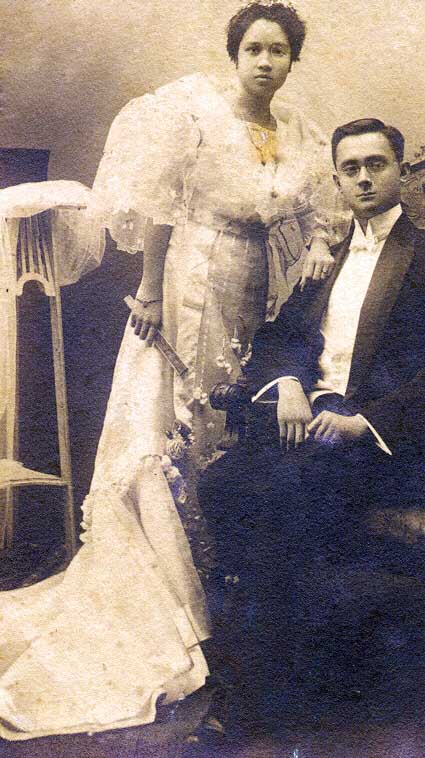
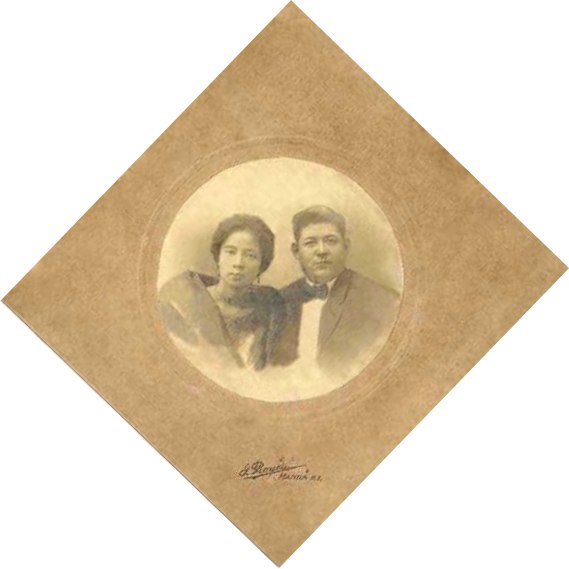
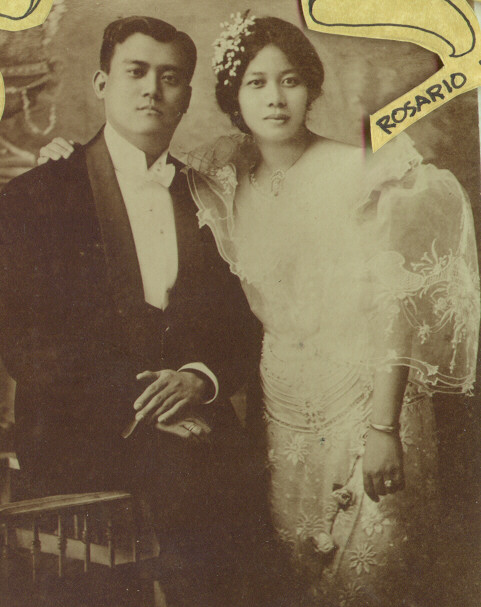
The handsome Gonzalez brothers were well-sought after in Pampanga’s  important social gatherings. They interacted  with all the buena familias  and who invariably were blood relatives with them. So it was no surprise to everyone that Emilio proposed marriage to Rosario “Charing” Valdez   y Liongson, another member of the rich families in Apalit. They got married on October 8, 1916 when Emilio was already 30 years old and Charing was a young 23 year old.

Emilio and Rosario

They had six children in succession, four boys and two girls. They were Joaquin “Jake” Thomas de Aquinas ( o 1918, and +1952), Romeo (o 1919 and +1988), Erlinda (o 1921), Rodolfo (o 1922 and +1952),  Raquel (o 1924 and + 2013) and Emilio Jr. (o 1926 and +2012), three of whom are alive to this date. [2]

Emilio died in 1925 due to complications arising from diabetes. He was 39 years old.

His young widow, 31- year old Doña Charing Valdez Gonzalez, became sad and depressed after this death.  Their  youngest son, Emilio, was born 7 months after the death of his father.   So, Augusto bought the house of Emilio in Sulipan, Apalit, and moved the widow and her children to Barrio Sta. Lucia,  San Fernando, ( capital of Pampanga)  where there were more people and activities to distract her. They just rented a house while they were there.

Doña Charing was only three years in San Fernando when her aunt, Florentina Valdez inherited a house in Baculud (now known as Bacolor) from Don Jose Talag. Florentina convinced Doña Charing to also buy a house in Baculud. This is where the children lived until they grew up. When they were living in Sta. Lucia, the children would just walk to school. When they moved to Baculud, they had to become interns “interna” and go home only during weekends.

JOAQUIN THOMAS DE AQUINAS GONZALEZ

Joaquin “Jake” Thomas de Aquinas Gonzalez was the eldest of the children of Emilio and Rosario Valdez.  He had a good career, married a girl from the affluent dela Rama family in Iloilo, and was socially active. He became the National President of the JAYCEE, a social group. He was on his way to Baguio for the National Convention to get reelected, when death overtook him.  His plane crashed in the mountains of Baguio and ended his life.

Jake and his wife had difficulty in  having children.  But at the time of the accident, his wife, Lourdes, had become pregnant with their first child.  So they decided that Jake take the trip to Baguio alone.  They were really looking forward to having the child and raising it. The child, Anne Marie, was born three months after Jake’s death.

Jake was 34 years old when he died in 1952.

ERLINDA GONZALEZ-RODRIGUEZ

(Erlinda was the third child of Emilio and Doña Charing.  She is the one who is narrating this story, so we continue with the story…..)

It was in Baculud (Bacolor) that Erlinda, or “Erly” as she was called, met her husband.  Her husband is  Jose Rodriguez, whose mother Victoria, comes from the wealthy  Hizon-Singian family from San Fernando. He had three aunts who were spinsters living in Baculud who were daughters of Godofredo Rodriguez, related to the mother of Florencia Sioco y Rodriguez, Matea Rodriguez.   In their family, the boys took care of the old people, so Jose took care  of his mother, Victoria Hizon, until her death.

When Erly’s mother died in 1976, she gave Erly the house. The house was a very classical antique house, and someone fell in love with it.  Erly sold the house before 1991, before the Mt. Pinatubo lava explosion buried all the houses in Bacolor.  The buyer hired a Jewish expert who dismantled the house piece by piece and brought it to Cavite where it now stands.

Erly and Pepe live in Quezon City. They have three sons and daughters who are all grown up and have families of their own.


[1] As narrated by Emilio’s daughter, Erlinda Gonzalez Rodriguez, to the author on November 12, 2011.

[2]  I have put a “o” to indicate the date of birth, and a “+” to indicate the date of death.

BIENVENIDO MARIA GONZALEZ Y SIOCO[1]

Bienvenido Maria Gonzalez y Sioco was born on March 22, 1893.  He was the eighth of the brood of ten boys born to Dr. Joaquin Gonzalez and Florencia Sioco.  He grew up in Sulipan, Apalit, Pampanga.

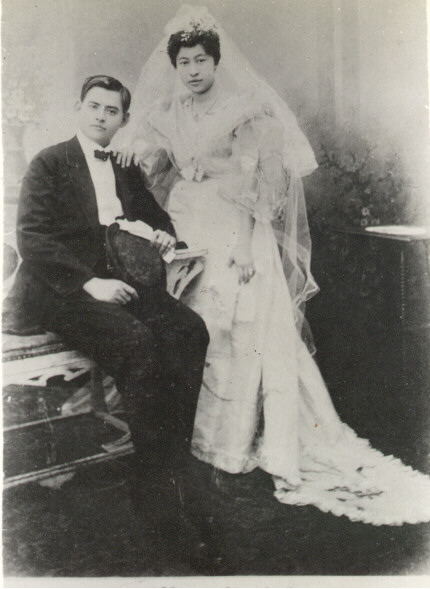
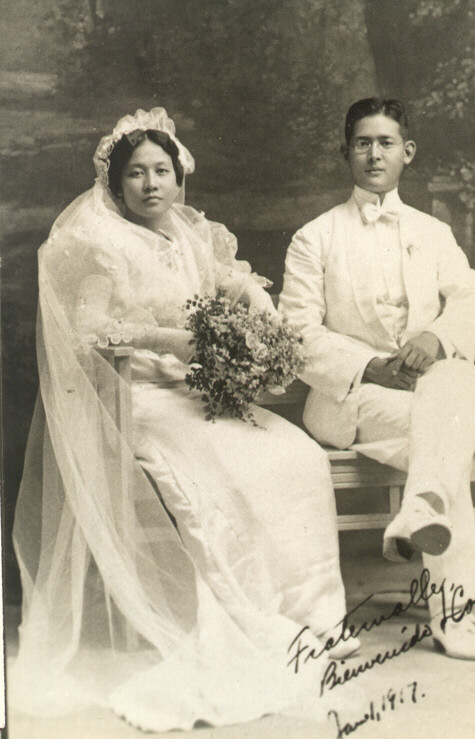
Bienvenido and Conchita Rafols, marriage picture

CHILDHOOD RECOLLECTIONS

One of the things Bienvenido relished during his childhood was his visits to the house of the Rodriguezes in Bacolor, Pampanga.  There he was the center of attention – what with his Tia Sepa (Josefa Rodriguez) and Tia Onyang (Gorgonia Rodriguez) pampering him with the attention he couldn’t get at home, what with so many brothers around!  His cousin Beatriz Rodriguez remembers that these two aunts would have him taken for a ride on a cart around the Plaza, just so he would eat his lunch.  Because of these fond memories, Bindo, as he was called for short, would visit these two aunts even after he reached adulthood.  Beatriz reported that, when Bindo became UP President, he went to the house of his aunts to inform them of his new appointment.  He even slept overnight in their house and left the next day.  Tia Sepa was later chosen to be Eva’s godmother at baptism.

GUARDIAN FOR THE YOUNGER BROTHERS

Bindo’s daughter, Eva, does not remember hearing her father relate many experiences with his mother and brothers.  But Bindo did tell her that his mother was quite strict, most probably to maintain order in their large family.  His mother, Florencia, asked the older brothers to help take care of the younger ones.  When Bindo went to Los Baños to study, Florencia designated Augusto, the fourth brother whom everyone called Titong, to be his guardian.  This relationship between Bindo and Titong lasted till the latter’s death in 1939.  Eva remembers her father’s making a special trip to Apalit to seek her Tio Titong’s counsel, before accepting the presidency of the University of the Philippines. He would have continued asking for his counsel, had Titong not lost his life to the Timbol brothers.

When his second-to-the-youngest brother, Joaquin, decided to take up agriculture, Bienvenido was made his guardian. This way, Bindo repeated the relationship he had with Titong, but this time, he was the guardian.

Dada Gonzalez Aragon, the daughter of Bindo’s older brother Dr. Jesus Gonzalez, to this day tells the story that, during her graduation ceremony from UP, her Tio Bindo stood up to kiss her to show recognition that she was related to him.  She felt elated over this experience.

Bienvenido was the first president of the UP Phi Kappa Phi international Honor Society in 1933.  When Nena Franco, the daughter of Dr. Fernando Gonzalez, the eldest of the Gonzalez boys, also became a member in 1935, her Tio Bindo went to congratulate her and said,

“So now you are my ‘sister.’”

Nena went home to her father to tell him that she, too, was now a sister of her father’s brother. Nena always looked for her Phi Kappa Phi pin to retell this story to her children, even before she died in 2009.

FAMILY LIFE

Bienvenido married Concepcion Rafols, who, at that time, was an academic supervisor in the City Schools of Manila.  They had five children, three boys and two girls.

Bienvenido’s family grew up in College, Laguna, where he spent 33 years—i.e., four years as a student, and the rest as a member of the faculty starting from instructor and ending as dean and professor.

To Eva, her Dad will always be remembered as a father who instilled discipline with humor.  He would make a joke of their misdemeanor, referring to it in such a manner that they’d vow to themselves, never to do it again.

One distinct story of Eva was when she used to enjoy sharpening her brand new Mongol pencil with the sharpener at school.  One day, she came home showing how small it had become.  Bienvenido didn’t say anything that first time, so she didn’t think she did anything wrong.  She did it again.  Before Bindo handed her a new pencil, he asked Eva to put out her hand and spanked it.  Eva doesn’t remember what he said as he did it.  He didn’t look angry.  But for many times on different occasions, he would humorously allude to his experiences so that Eva resolved never to do it again.

Bienvenido was strict, but he hardly inflicted physical punishment except for that one time when he did.  But he used his belt on his son Gonzalo, his nephews Vladimir and Benjamin, when they came home with report cards showing a grade of “E” for bad conduct at the Maquiling Elementary School. It was his wife Conching who used her leather slipper on the kids. Gonzalo and Eva were the most frequent recipients.  She would make them “sila” – which means, to sit at opposite corners of the room and only release them after they had promised to behave.

Like most Filipino households, it was often Conching who laid out the rules – with Bindo’s consent, of course.  The boys could not go out to play with friends on Saturdays until they mowed the lawn or cleaned the cars.  The all had to say, “Mom, I’m home” upon entering the house, and of course, ask permission if they wanted to go out to play. That was part of their discipline.  Such training served them well as they grew up, even if they didn’t enjoy it at that time.

PROFESSIONAL ACCOMPLISHMENTS

Bienvenido studied at San Juan de Letran in Manila, and then he took up agriculture at the U.P. College of Agriculture, College, Laguna, acquiring a bachelor’s degree in 1913. He then studied at the University of Wisconsin, and received a Master of Science Degree in 1916.  Later, he obtained a Doctor of Science Degree at the Johns Hopkins University, U.S.A in 1924.

On April 21, 1939, The UP Board of Regents elected Bienvenido M. Gonzalez to the UP Presidency.  At the time of his election, Bienvenido was dean of the College of Agriculture at Los Baños.  At the age of 46, he was the first UP alumnus to head his Alma Mater.

Dr. Gonzalez was inaugurated on October 19, 1939 to coincide with the founding of Universidad Cientifico-Literaria de Filipinas of the first Philippine Republic in Malolos.  The UP remembered that Bienvenido’s father, Dr. Joaquin Gonzalez, was the first Rector of the Universidad Cientifico Literaria de Filipinas, to which the University of the Philippines may trace its origin.[2]

Fifty-eight years after his death, Bienvenido is remembered for many things.  Bienvenido became the sixth President of the University of the Philippines before the War broke out.  The most significant thing he did during his tenure as UP President was to relocate the University of the Philippines from congested Manila to Diliman, Quezon City.

The second thing for which Bienvenido is remembered for was his moral fiber.  President Manuel L. Quezon was quoted to say during his Bienvenido’s inauguration, “… he possesses that moral fiber with which educational leaders should be endowed.  Here is a living example which the constituency of the University may well emulate.  It teaches the secondary importance of material wealth and the priceless value of service.”

It was the same moral fiber that caused Bienvenido to be ousted.  Bienvenido refused the recommendation of President Quirino to grant an honorary degree to Indonesian President Sukarno during the latter’s visit to the Philippines.  Bindo classified President Sukarno as a “rebel” and not worthy of an honorary degree at the State University.  Instead, Bindo invited the then ex–Justice Claro M. Recto as the guest speaker at the UP commencement exercise on April 23, 1951.

This act of the replacement of Bienvenido as UP President resulted in the first demonstration of students from the Diliman campus.  The 1951 Philippinensian reported,

“But the University spirit was already full grown and could no longer be cowed by power.  It was this spirit which inspired the UP youth to march to Malacañang to protest to act of Elpidio Quirino and his men in the Board of Regents, in virtually forcing the retirement of President Bienvenido M. Gonzalez. And to this end, the students were willing and ready to defy the heat of the noon-day sun, hunger and even the law itself.

In their manifest, the students declared:  “We stand for the principle that the state university should be free from political interference.  No official in the government, however high or might, should trample upon the independence of this institution”[3]

Even before Bienvenido became UP President, he was already known internationally for developing the Philamin cattle, Benkjale pig, Cantonese chicken and the famous Santa Gertrudes cattle.  As Dean of the College of Agriculture in Los Baños, the College became the acknowledged leader in the scientific field in the Country.  Children of rich families were sent to the College for their education.  Dr. Gonzalez followed his oft-repeated remark to the letter,

“I want every product of this College, whether it be a student, a plant, a domestic animal, or a scientific paper, to bear a mark similar to that of ‘sterling’ on silver.”[4]

Bienvenido was president from April 21, 1939 to October 1943, and from June 28, 1945 to September 23, 1951.  He died on December 30, 1953.  He was conferred posthumously in 1957 by his Alma Mater, the degree of Doctor of Laws, honoris causa.


[1] Eva Gonzalez, “Memories”, October 13, 2004.  Her thoughts on her father.

[2] “The UP Presidency through the years,” Carillon, January-June 1983, Diliman, Quezon City, p.11.

[3] “The UP Presidency through the years,” ibid., pp.13-15.

[4] Philippine Collegian, Vol. XXI, No. 19, Manila, October 19, 1949.  P.5.

AUGUSTO DIOSDADO GONZALEZ Y SIOCO

Augusto Gonzalez was the millionaire among the ten brothers.  He was the one with the aptitude for making money.  In contrast, his  oldest brother Fernando was more interested in  stamp and coin collection, as well as in  astronomy. Fernando  spent his money on a big telescope to map out the constellations. Augusto’s  second brother, Jesus, was a distinguished doctor.

BUSINESS ACUMEN

Even as a child of 10, Augusto  helped his parents in administering  their farmlands. As a teen, aside from helping his widowed mother run their business affairs, he also helped his aunt Sabina Sioco de Escaler run her agricultural properties. As a young adult, he helped his aunt Sabina and cousin Jose (Pepe) acquire more and more agricultural and commercial properties in Pampanga and Manila. He helped make the Escalers very rich. As his business acumen became known, Pampanga’s richest families like the de Leon-Joven, Lazatin-Singian, Hizon-Singian approached Augusto to join them in their various businesses to ensure their management and profitability. He also helped make the de Leons of Bacolor very rich.

FIRST MARRIAGE

Augusto had two marriages.  His first marriage was to his first cousin Marina “Maring” Escaler, whose mother, Sabina, was the sister of Augusto’s mother Florencia. Maring had a big crush on him. They were both water signs: she was a home-loving Cancerian and he was a sexy Scorpio. Maring insisted on the marriage. [1]

Augusto and Marina Escaler

So they married in 1909, at 4:00 a.m. in the Apalit Church.  It was an unexpectedly very happy marriage and he genuinely mourned her passing in 1928.

They had eight children, but only three of them lived to adulthood: Rogerio, Elsa and Cristeto.

When their mother Florencia died in 1925, Augusto saw that the lands to be inherited among him and his brothers were a pittance. He worried about his brothers, and wanted them to have more so they could support themselves with their inheritance. So he held off distributing the land until Augusto was able to augment the landholdings. When he saw that each of the brothers had at least a value of P8, 000.00 including shares of Pasudeco Stocks, for each of them, he went through with the distribution of the assets of the estate. [2]

MILESTONES IN HIS LIFE

Every time Augusto made money, he marked each milestone with a contribution to the Apalit community.  His first contribution was to redo the Apalit Church which was needed repairs.  He painted the dome a startling black color.  However, after this was done, several family members died—Marina (1928), Virgilio , Javier, and Amparo dela Rama, wife of Fausto (– all 1929),  the color was changed into silver.  That stopped the deaths from continuing.

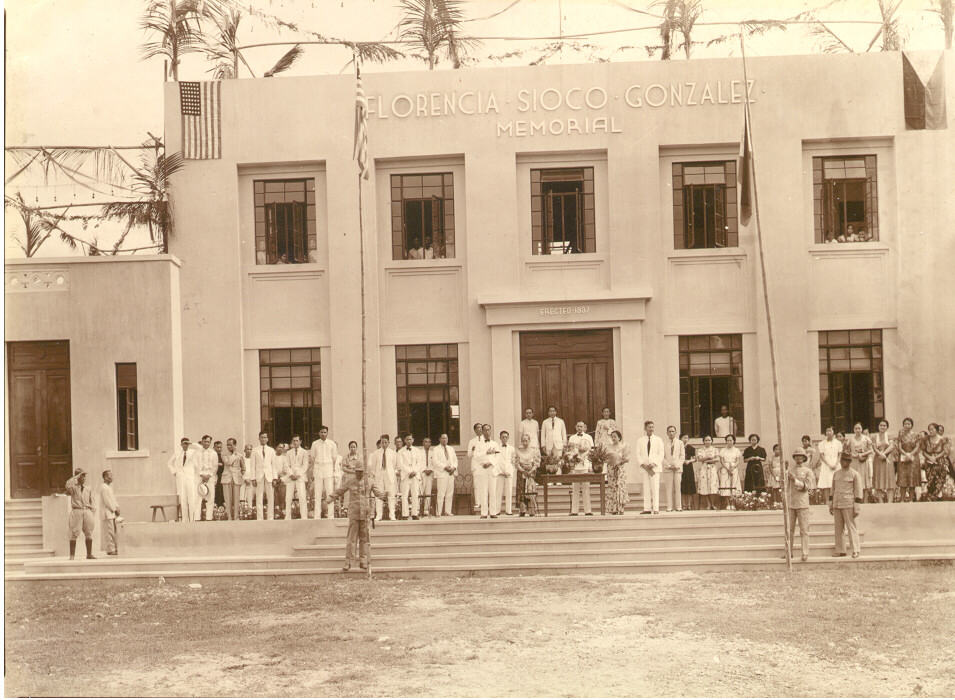
Inauguration of the Florencia Sioco Municipal Hall

Augusto will be most remembered for putting up the Florencia Sioco Gonzalez Memorial Hall, the Municipal Hall of Apalit.  After he made his next million, he put aside P35, 000 for the construction of this hall.  He inaugurated the Municipal hall on May 21, 1938. His guests included all the VIPs around Pampanga and Bulacan and Manila.

REMARRIAGE

When Maring died of asthma complications in 1928, Augusto, or “Bosto” as he was fondly called, was only 41 years old and still a virile man. He went into “quick affairs” with common women in San Fernando.  His Rodriguez aunt Gorgonia found out and insisted that he marry again. He courted his first cousin Jose Escaler’s widow Aurea “Auring” Ocampo (viuda) de Escaler against the advice of his Jesuit confessor that: “children yours, hers, and yours, together a miserable life will make.” His widowed sister-in-law, Rosario “Charing” Valdes-Gonzalez, also let it be known that she would not mind marrying him. But he also simultaneously courted his niece Rosario “Charing” Espiritu Arnedo, daughter of his first cousin, former Pampanga Governor Macario “Ariong” Sioco Arnedo. The former governor owed his first cousin Augusto Sioco Gonzalez more than Php 50,000 cash plus interest spent on politics. Charing had a boyfriend of modest means whom her parents didn’t approve of.  Sp when the superrich Augusto came sailing along with gold and diamond rings, earrings, and  bracelets from “La Estrella del Norte” on Escolta for all the ladies of the Arnedo family, Ariong and his wife Maria “Maruja” forced their daughter to accept her uncle’s marriage proposal. Amid many recriminations, Charing accepted out of obedience to her parents. She learned to love him eventually because he was very good to her.

The very next day after Rosario had accepted Augusto’s proposal, Aurea Ocampo (viuda) de Escaler sent word that she was accepting Augusto’s marriage proposal, but it was too late.

Augusto and Rosario Arnedo

It was during his marriage to Doña Charing that Augusto hit his professional peak and productivity, amassing agricultural properties all over Pampanga, Nueva Ecija and Bulacan, and commercial properties in Manila at an impressive rate. Despite all his money, the family lived simply, no frills. Augusto constantly reminded Doña Charing:

“We have to live simply because we are accumulating capital for our children.”

When Augusto’s eldest brother Fernando lay dying in Augusto’s house in Tennessee, Malate, Manila, Augusto also told his brothers Fernando and Fausto,

“I will work very hard because I want my children with Charing to be as rich as mine are with Maring.”

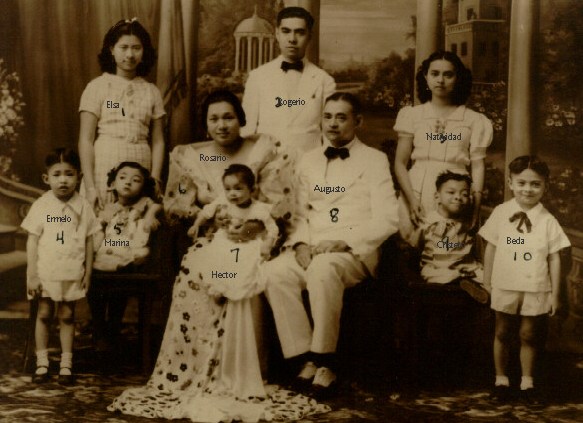
Augusto, Rosario and all the children from both wives

He also took this opportunity to berate his youngest brother Fausto, for being so ostentatious.  He commented that he, Augusto, despite his wealth,  only got by with two “de hilo” suits and four long-sleeved shirts (camisas dentros”), while Fausto always wore the latest fashions matched with the most expensive shoes.  He told Fausto,

“Those excess clothing could be better invested wisely”.

The marriage of Doña Rosario with Augusto  produced seven children, two of which died in infancy. Brother Andrew Gonzalez, president emeritus of De La Salle University, Manila, was the youngest of their children.All in all, I think it would be good if the only things mentioned about our side of the family is that Lola Charing was an Arnedo, of the old & prominent Sulipan, Apalit family; the enumeration of their children: Marina Arsenia, Augusto Beda, Ermelo Efren, Hector Argeo, + Heraclio Julio [infant, fatally injured when the young Hector hit his mother’s stomach with a baseball bat], + Macario Domingo [infant, like Cristeto & Marina], & Macario Diosdado; and the fact that Macario Diosdado Arnedo Gonzalez a.k.a. Brother Andrew Benjamin Gonzalez F.S.C., o 1940- + 2006, was one of the most accomplished & important Gonzalezes who ever lived. I know he would like that description because that was the driving force of his entire life and that was how he wanted to be remembered in the family. 🙂


[1] Toto Gonzalez, “Remembrance of Things Awry, “his blog on the Gonzalez and other relatives. He quoted Eglantine Gonzalez Franco at several points of his treatise.

[2] Estados Unidos de America Islas Filipinas, Juzgado de Primera Instancia de Pampanga, Septimo Distrito Judicial, “Testamentaria de La Finada (de) Dña Florencio Sioco vda. De Gonzalez, Causa Civil No. 3299.August 28, 1927. 5pp.

DR. JESUS GONZALEZ Y SIOCO

 Dr. Jesus Lope Gonzalez y Sioco was the second son of  Dr. Joaquin Gonzalez and Florencia Sioco.   He was born on September 25, 1885, just less than a year from his elder brother, Fernando.  He, Fernando, and Virgilio became medical doctors.

Dr. Jesus and Eliodora

MASELANG BABI

When you mention Dr. Jesus Gonzalez’ name to any relative who knew him, the first way they would describe him would be “maselang babi”, meaning “meticulous pig” as he was very scrupulous in his cleanliness.  As a young boy, he forbade Mena, one of their  beluga[1][1] cleaning women, to sweep his floor with a broom when he was around.  He said that whenever she did this, the dust would fly into the air and infect his room with germs.  So he preferred to clean his own room himself.  But he was so busy, his room would remain messy and untidy for a long period, a situation which drove his mother up the wall.  So everyone called him, “maselang babi.”  He was so meticulous, but would not get himself to clean his own room.

One anecdote along this line was that, whenever Jesus washed his hands, he would use three bars of soap—one for washing his hands when they were still dirty, the second bar after his hands were already relatively clean, and the third for the final rinsing.

His children remember that, during Christmas time, when friends and relatives would give coins to his children as presents, Dr. Jesus would be so worried that his children would get sick from what he thought were “those dirty coins”,  so he forbade the children to touch the coins. Instead, he put them himself into their piggy banks.

When his second wife, Mercedes, got sick with typhoid, his cousin “Imang” Betz Rodriguez was requested to give Mercedes her injections.  Jesus asked Betz not to wipe her hands after washing.  Instead, she should dry her hands by flailing them in the air until they were dry. This was to prevent her from catching germs from the towels.

FIRST WIFE  ELIODORA ESPIRITU

Dr. Jesus married his wife Eliodora “Orang” Espiritu when he was 26 years old and she was 25.  Orang  came from the well known family of the Espiritus of Sulipan, Apalit. This was considered a good match for the two well-known families in Sulipan– the Gonzalezes on one hand and the Espiritus on the other.

Orang  also shared the fastidiousness over cleanliness of Dr. Jesus. She would tell her grandchildren from her adopted daughter,  Julia,

“Don’t touch me”.

She continually washed her hands with alcohol, when they were soiled. .

She would change her beddings and pillowcases every day. But she allowed her grandchildren to sleep on her bed.[2]

Dr. Jesus and Orang had twins, but they were still born. She preserved them in a jar until her death in 1975. Her granddaughter buried the jar with Orang’s remains.  When daughter Julia gave birth to twins, Renzi and Rendell, Orang was ecstatic. She  felt that they were the reincarnation of her own twins.  She would be seen crying in front of the jar at times.

Orang was of strong character. She would put on her helmet and drive around in a car with the top down.  She enjoyed eating good food, and her favorite was “paros-paros”—a shelled prawn that was fried with laurel and crispy minced garlic. She loved imported chocolates. She had a whole tocador—a dresser — full of imported perfume and jewelry boxes.

Unfortunately, her individuality later caused the break-up of her marriage.

SECOND WIFE:  MERCEDES VELOSO

Mercedes was the exact opposite of Orang. She was soft, loving, and totally subservient to her husband.  How Dr. Jesus and Mercedes met is not known to anyone within reach anymore. Eventually, the first child of Mercedes was born. Her name was Imelda, and Imelda was born on October 3, 1921.  Two other children came in succession—Leonardo (1922)  and Cristina (1923).

The first cousins, children of Friar Fausto and Mariquita Gonzalez, were very close to each other. They would spend their holidays together.  They went to dances and other social gatherings together.  The children of Dr. Joaquin were in Apalit and Dr. Joaquin’s siblings – Soledad, Carmen, Jose, and Francisco—stayed in Baliwag.  So the cousins took turns visiting each other.  When they married, they stood as godfathers to each other’s children.  For instance, Dr. Virgilio, son of Dr. Joaquin, was godfather to Ruben, son of Soledad with Mariano Gonzales.[3]

When Dr. Jesus was already deep in his involvement with Mercedes, he needed to do something to house his growing family.  So he asked Ceferino, who was his close friend, whether Mercedes and her children could stay with them.

At this time, Ceferino had also gotten himself  in the same predicament as Dr. Jesus.  Ceferino had also started a second family.  He had gotten involved with his wife’s cousin, Magdalena de Lara, who was working in their house. They had a daughter, Crescenciana. Two other children followed later, Edita and Gaston.

Ceferino, therefore, allowed Dr. Jesus to move his growing family into their house.  Dr. Jesus put up a wall in one of their bigger rooms, installed a lock, through which one could enter.  When Ceferino died, it was the turn of Dr. Jesus to allow Magdalena and her three children to move in with them. Dr. Jesus moved the family of Mercedes to Quezon City in 1939.  By this time, he had ten  children—one of whom, Carolina, died in infancy, Milagros (1927), Antonio (1928), Geronimo (1929),  Adelaida (1931), Jesus  Jr. (1937) and Remedios (1940)..

After a while,  Orang also moved to Quezon City.  She had a house from Apalit that was owned by her father, dismantled and rebuilt.  She lived on Blumentritt Street in La Loma, at the border of Quezon City and Manila until her death on March 12, 1975. She adopted a baby whom she named Julia (1932), whom she trained well in the matters of running a house.  Julia was the source of Orang’s great happiness, especially after Julia married the son of the brother of Dr. Jesus, so that Julia became a Gonzalez herself.

THE PROFESSIONAL LIFE OF DR. JESUS GONZALEZ

Dr. Jesus trained in Munich, Germany for four years after getting his degree in medicine.   People would travel far and wide to be cured by him.

One such story close to my heart was about a certain  four-year old boy from nearby San Luis, Pampanga. [4]  His name was Luis Franco, and he had been stricken with the deadly disease, typhoid fever.  San Luis was a small town without a hospital, so the doctors advised him to go for treatment to the clinic of Dr. Jesus Gonzalez. This was located in Manila, most likely in Tondo.

Luis and his mother travelled by banca[5] to Calumpit, located along the Pampanga River. From Calumpit, they took the train to Manila, where Dr. Jesus had his clinic. Luis was already having difficulty in breathing.   Dr. Jesus quickly inserted a tube in Luis’ trachea, and the young patient immediately started to regain his rosy color.  Luis’ mother  P300, enough money in those days to buy a few hectares of land. But she did not mind forking the money over, since Dr. Jesus had saved the life of her only son. What was money in comparison with the life of your own blood?

Luis grew up to become a doctor himself.  He married the niece of Dr. Jesus, Eglantine, daughter of  his elder brother, Dr. Fernando.  At one time, there were six  houses on the same street (then called South 9th) owned by the brothers.  Three belonged to Augusto—his second wife Doña Rosario and her children, another one to Rogerio, Augusto’s eldest son, another to Sabina Escaler, his aunt—and the others belonged to Fausto (opposite that of Mercedes), plus that of Fernando and Mercedes.  When Dr. Jesus moved to Quezon City, Dr. Fernando and his other brothers followed suit. They all became neighbors.  After Dr. Jesus died, Dr. Luis Franco became the doctor of Dr. Jesus’ widow, Mercedes, and cared for her until she died in 1970.

LOVE ‘TILL THE END OF HIS LIFE.

Dr. Jesus had a very happy life.  His wife, Mercedes, adored him.  He fondly called her “Hija” (my daughter).   There was a thirteen- year gap between them. She responded with a soft, “Jesús, Mio”  (My Jesús).

Orang accepted the fact that she lost her husband to a woman who was more compatible with him.    When she learned that Dr. Jesus was seriously ill,  she went to visit her husband in Mercedes’ house, in a sincere manifestation of forgiveness toward him and sympathy toward his family.

Dr. Jesus died in Quezon City on September 23, 1941. He was 55 years old.


 [1] Aeta—  curly haired aborigines who came from the mountains of Zambales, and were considered as having very low level of intelligence.

[2] Rendel Gonzalez, son of Rene and Julia Gonzalez,  as narrated to the author, on June 2011.

[3] Eva Iral, on her memories of her father, Ceferino and Dr. Jesus Gonzalez, as narrated to the author on October 13, 2009.

[4]  Dr. Luis Franco, in his memories of Dr. Jesus Gonzalez, as narrated to the author in 1998.

[5] Banca was a small boat without any rigs at the side.

FERNANDO GONZALEZ- SIOCO
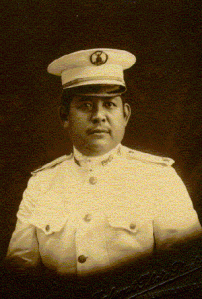
Dr. Fernando Gonzalez

Fernando was the eldest of the ten sons of the Dr. Joaquin Gonzalez and Florencia Sioco.  He was  the first of 5 doctors, 3 of whom are doctors of medicine (Fernando, Jesus, and Virgilio), one doctor of Science (Bienvenido) and the youngest (Fausto) doctor of Laws, from the University of Madrid.

“GENIUS IN THE FAMILY”

According to his brother Augusto, Fernando was the “genius in the family”. He excelled in the languages: German, which he did a self study in order to pursue his stamp and coin collections ) French, Spanish, English, Tagalog and even Sanskrit. -He was so proficient in these languages that he was able to write stories and plays in these languages. His wife Clementina had a musical family, and they enacted these musicales in public in San Luis. Teodoro M. Kalaw, National Library Director, met Fernando’s daughter, Eglantine, in 1933. He told her, “I knew your grandfather – Joaquin. He was a brilliant man. I knew too your father, Fernando. He was a brilliant man, too.” And the rejoiner of the daughter was not less flattering.

ARTIST,  PHILOLOGIST AND A TEACHER

Fernando was like his father, Joaquin, when the latter was young.  He was quiet and liked to do things with his hands.  One time, his aunt Soledad (sister of Joaquin) tried to help Fernando in making some art work.  She wound up messing up the job. Fernando cried and ran to his father.  Joaquin, amused that his son would be better than his sister, pretended to castigate him.  But after Fernando was out of hearing distance, he told his sister, “You should be ashamed that this eight-year old boy can do better work than you.”

Fernando’s love for the arts was so profound that he thought of becoming a philologist and a teacher, excelling in the languages.  At that time, and even to this date, these professions were not sufficient to support a family.  So his father discouraged him. Jokingly, Joaquin told him, “If you do this, you would need to wear a wide band of cloth on your forehead and hang a bolo or scythe at your waist, then be a thief, ready to rob people to support your family”. So Fernando took up medicine instead.

As a student, Fernando was easy-going. He didn’t need to study hard to get good grades. He didn’t buy his books. His classmates supplied him or lent him their books so Fernando could be able to participate in their classroom discussions. If, by chance, he did not attend class to visit to his lady love, the woman he married later, the whole class also preferred to boycott their class rather than be called to carry on the discussion of the day without Fernando.

HIS COURTSHIP OF HIS WIFE, CLEMENTINA

Fernando, being the eldest in the marriage of high profile parents, Dr. Joaquin Gonzalez and Florencia Sioco, had the pick of the eligible rich and “de buena familias” of the whole of Pampanga.  He often told his daughter, Eglantine,

“I could have married any of  the richest and most beautiful women in Pampanga during my time.  But I chose your mother for her simplicity.  I found the other women very spoiled and not to my liking.”

He met Clementina while Fernando was a medical student and  she went to Azcarraga (now Claro M. Recto Avenue) in Manila, to work as a Teacher.  Although Clementina herself owned several haciendas in San Luis, Pampanga, they were subject to floods, drought, and pests.  Her father sent her and her two siblings to work as teachers in Manila. Fernando visited her almost daily,  accompanied by one of his friends. Clementina thought he was interested in her more vivacious sister, Josefa, so she prayed to St. Anthony to give her a sign if he was at all interested in her.  At the deadline that Tinang gave to St. Anthony, Fernando slipped into her lesson plan a love letter.

They married on the day of the fiesta of San Luis.  Late on the night of June 21,m 1910, Fernando arrived with his mother Doña Florencia Sioco de Gonzalez and his brother Augusto, ostensibly to attend the town fiesta. They passed the night at the Elizalde house, but at 4:00 o’clock in the morning of the 22nd, Fernando and Clementina, dressed in their finest, were married at the main altar of the parish church.  After a simple breakfast reception, the couple left for Manila for a seven-day honeymoon.[1]


[1] Eglantine J. Gonzalez-Franco, Doña Clementina Elizalde-Gonzalez:  A Tribute.  Quezon City, Philippines, p.7.
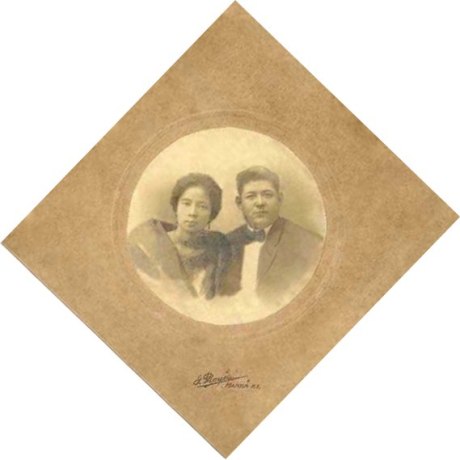
Clementina and Fernando

“DOCTOR PROVINCIAL”
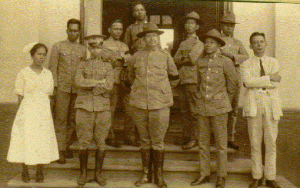
In a Provincial Hospital

Fernando went on to become “Doctor of the Provincial.” He was stationed in La Union and Rizal. As a sanitary health officer, he enforced strict health rules. He forbade women to wash clothes in artesian wells. His men had to wear uniforms at all times. Meat sold in markets had to be checked. It was necessary to be strict at that time, since typhoid and other communicable intestinal diseases were widespread and caused a lot of deaths everywhere.

In his own house, Fernando disliked fermented food that was so popular in Pampanga. He forbade his family to serve buro (fermented shrimps in rice) and  balo-balo (fermented fish in rice) whenever he was around.

Before he retired, he accepted an assignment in Manila, so he could be promoted. This was where death found him.

COMMANDING PERSONALITY

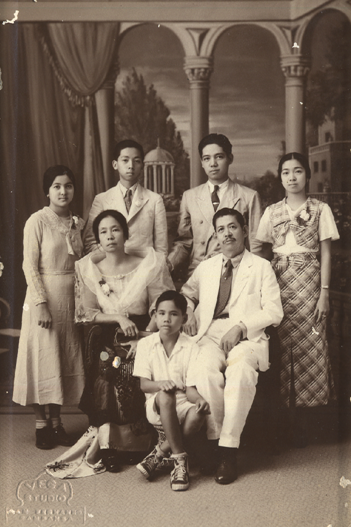
Fernando sported well shaped whiskers which added a aura of formality and strictness to his personality . His son-in-law, Dr. Luis B. Franco, always joked that he was intimidated by the movement of the whiskers of Fernando, which indicated his displeasure. So Luis always kept away from Fernando’s sight, making friends with his future wife Eglantine’s brother, Amaury, as a pretext to see Eglantine.
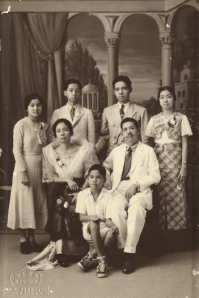
Fernando and Family 1935

Fernando also had a booming voice, which was characteristic of those who lived in huge houses.  However, his sawali house in San Luis was not as big as his mother’s bahay na bato in Apalit.  Aviong Ramirez recalled that they could hear his Tio Dando’s voice several houses away from where they lived.  Fernando would be heard calling their cook, “Marciana! Marciana!”  many times during the day.  And the whole community who  heard these calls, wondered what he would need from Marciana that he would need to call her many times during the day.

Lo cortez no quita lo valiente

Fernando was courtesy personified, a gentleman. He was fond of saying: “Lo cortez no quita lo valiente” Courtesy will not make you less a man. His daughter, Eglantine, remembers that, “as a young girl of 18 to 21 years, he showed me the utmost courtesy. I felt like a lady of consequence, with him leading the way to theaters, allowing me to go before him through doors when entering rooms, or assisting me in going up or down calesas or cars, always behaving the perfect gentleman that he was.”

To his family, Fernando was a loving family man and a pillar of strength to his very much dependent family.  He combined discipline and love and tried to impart to his children the values a father would like to give to his children, particularly regarding  money, humility, and family honor.

His eldest daughter Eglantine remembers this of her father: “He was strict in the way he let me handle my allowance – always with an accounting until the next one was given. He said it was a part of my education — the knowledge to handle money.” Such was the discipline Fernando imparted to Eglantine regarding money, that she became a successful business woman.

Eglantine also adds, “Humility was a virtue he exacted of me. Being the only girl in a big family of boys, I had the tendency to make capricho as my father termed it. He told me “No matter how beautiful, or how rich a girl is, she is nothing to me if she is spoiled – caprichosa. I had the best chance to marry the most beautiful, the richest and the most intelligent girls not only in Pampanga but in Manila and other provinces as well. They were nothing to me since they were spoiled girls. Instead I chose your mother who is simple, sweet and unspoiled, not the exigent or demanding type.”

FREE MASON

Fernando was recruited by Pepe Escaler to become a Free Mason when he was already an adult.  However, his wife, Clementina continued to be a Catholic.  He admonished the children to continue in the religion of their mother until they were 21 years old. When Catholic schools opened in San Fernando where he was assigned, he let the children study in them.

NATIONALISTIC

Fernando was ultra nationalistic preferring to be” ruled like hell by Filipinos rather than ruled like heaven by Americans.” (President Manuel Quezon had this same philosophy.) At one point in his life, he wanted to go into politics, but was dissuaded by his family.  However, after his retirement from the Bureau of Health, he decided to serve the country as a councilor of San Luis without pay. He could have ran for mayor but preferred not to.  He won easily, garnering more votes than the popular mayor who was re-elected. His being an idealist was, after all,  not lost to the town people who saw sincerity and simplicity on a son of a proud family– the Gonzalez of Apalit. In fact, the people from Apalit who knew the Gonzalezes as prominent and belonging to the upper class strata of society,  were surprised that even the small people loved Fernando to give him their votes.

Fernando’s political view at that time was “Anti-Independencia”. When his view ran counter to his brother Fausto’s “Pro-Independencia”,  Fernando withdrew into the background.  His wife Tinang became the campaign manager of Fausto in San Luis.

COMMON TOUCH

Fernando really had the “common touch”.  His tenants, the few who are still alive, in San Simon, Pampanga, regale stories to this day, remembering Fernando as someone who was “one of us”. During harvest time, he would visit the tenants and be with them during the duration of this period.  Naturally, mealtimes would descend on everybody, and Fernando thought nothing of eating in their homes, using his hands to eat, same as did the tenants. The tenants would set aside his share of the harvest, and Fernando, in a show of benevolence and generosity, would take a bundle of the rice harvest and give it to anyone he favored, to show his appreciation of their hard work. The camaraderie of tenant and landlord was strong between Fernando and his tenants.

As Doctor Provincial, he found himself with the people a lot. When the people offered him their “native delicacies”, such as  adobong iguanas, or snakes, he swallowed his revulsion of what was being offered to him, and accepted gracefully, even to the extent of pretending to like what was being offered to him. This was part of his courtesy, and polite demeanor.

THE PLEBEIAN GONZALEZ

Even if Augusto called Fernando “the genius in the family, he also called Fernando, “the dreamer.” While Augusto and Fausto went into high profile with their success in business and politics, they were a bit disappointed that their elder brother did not use his genius to create more money.

Augusto and Fausto laughed at Dando’s (Fernando’s nickname)  way of living.  While they (Augusto and Fausto) wore the latest fashions, drove the most expensive cars, Dando wore a camiseta and calconsillo,  drove a rickety car, a vintage Ford which often broke down.  Many times, Dando would be seen in the streets of San Luis, pushing his car with the aid of his maids and children, so it would start.

When Dando would go to Manila, he would take a truck.  His brothers would tease him,

            “Ayan ne y Dando, maca “Marcelo Diaz” ne naman!”

Marcelo Diaz owned the only truck from San Luis that went all the way to Manila.  Dando would use this truck to go to Manila when he went to visit his brothers.  “Marcelo Diaz” was a pun on “Mercedes Benz”.  Instead of riding a Mercedes Benz, Dando rode a “Marcelo Diaz” truck.

Even Fernando’s daughter, Eglantine was disappointed in her father.

“What?  A Doctor Provincial? Living in a house made of sawali?”

All the years that they were stationed in different parts of  Luzon, Eglantine accepted that they would live in rented houses. But when her father retired, she was expecting to live in a more comfortable house, maybe not unlike his mother Doña Florencia’s bahay na bato. So she was very disappointed that her father, whom she worshiped, the “Doctor Provincial of many hospitals, and respected by all, would return to live in San Luis, build his house in a lot inherited by his wife, Clementina, and made from sawali, or thatched bamboo, at that!  Eglantine swore that she would do better than her father, when the time came. And she did.

It was recently revealed to this author that the reason Fernando liked the sawali was because the air flowed easily through the house through the holes between the bamboo weaves. After Fernando died, the sawali was replaced by wood.

“DELCO”  GENERATOR

The only concession that revealed the truth that Fernando came from the wealthy Gonzalez family was his ownership of a “Delco” generator.  It was made of wet cells, and lighted up the chandelier in their living room and enabled them to listen to their classical music via their gramophone.  They were the only ones in the whole town who had a generator.  Before dusk, Fernando would gather his houseboys, and together they would start the generator, filling the whole town with its start-up noise. For lights, they had the “Aladdin” lamps.

SEARS AND ROEBUCK

One of the fond memories of the nieces and nephews of Clementina of  their Uncle Tio Dando were the gifts they received from him every Christmas.  A few weeks before Christmas, Fernando’s  order of  candies and toys from the  Sears and Roebuck would arrive.  These memories have stayed with Sofie Elizalde and Aviong Ramirez to this date.  They could not imagine how Fernando would painstakingly take the children’s characters and order presents that suited them perfectly, from the United States of America, at that! The Sears and Roebuck was also the source of the characters of the dioramas that Fernando fashioned for his children. He made dioramas depicting scenes of rural life, or war, and daily life.

 “UPHOLD THE FAMILY NAME”

Fernando had a strong obsession in upholding the honor of the family name. At that time, the Gonzalezes of Apalit had carved a niche for themselves in society.  Their father, Joaquin, was one of those who drafted the Malolos Constitution.  Fernando’s brothers, Augusto and Fausto, were well-known in the field of commerce and politics, respectively. Augusto had become a millionaire and married an Arnedo, the daughter of the political kingpin of Apalit, Macario Arnedo. Fausto, their youngest brother, was in the political limelight as a  congressman. However,  Fausto was still continuing with his naughty behavior which he had even when he was small. On his deathbed, Fernando called these two brothers and admonished them to be careful and keep the family name unsullied and untarnished.  These were his last words as he lapsed into unconsciousness, and died after two days.

This was Fernando. He never made money but he gave a shining example of honesty and integrity and an unselfish unblemished public service. This was Dando, happy in his camiseta and calconsillo, happily pushing his old Ford, composing plays and operettas, working for the poor.  The Plebeian Gonzalez.

FAUSTO AND AUGUSTO HELP THE FAMILY OF FERNANDO

Fernando died in one of the many properties of Augusto, in Malate, Manila.  After he died, Tinang (Fernando’s wife) asked Augusto if she could have the property for sentimental reasons.  Augusto gladly gave it to her, on condition that she pay off the amortization.  When Fausto heard this, he also offered to Clementina, another property that he was paying mortgage on. This was in Paco.    These two properties were eventually paid in full by Clementina, and these  helped her have a better life with the rental income until her death in 1991, at 110 years old.

Even in death, the brothers continued their guardianship of each other. Such was their love for one another.
Wedding Picture of Florencia and Joaquin

Florencia Sioco was the daughter of Josef Sioco of Bocaue, Bulacan and Matea Rodriguez of Bacolor, Pampanga.  She was  24 years old when she married Dr. Joaquin Gonzalez, a son of a Spanish friar and Mariquita Gonzalez, of Baliwag, Bulacan.  After their marriage, the couple settled in Barrio Sulipan, Apalit, where he ran a clinic.  She and Joaquin had ten sons within thirteen years after their marriage. Her husband was engrossed in his medical profession. He became a delegate of the Constitutional Convention in Malolos.  Then he became a member of Aguinaldo’s cabinet. Then he was appointed as President of the Universided Sciencia, Literaria y Cultura. Then the Americans came, and Dr. Gonzalez was appointed to become chairman of a three-man civil service board with two Americans as members.  Before he could assume office, Dr. Gonzalez died suddenly of acute appendicitis in September 21, 1900, at the age of 47.

DELEGATING AUTHORITY

Any ordinary woman would have been fazed by all these things happening around her, like a whirlpool. But Florencia took tight rein on her household.  Her son, Bienvenido, told his daughter, Eva, that his mother was “quite strict”. She had to do this to maintain order in their large family.   Florencia told the older brothers to help take care of the younger ones.   When Bienvenido (Bindo) went to Los Baños to study, Florencia designated, Augusto, the fourth brother whom everyone called Titong, to be his guardian.  This relationship between  Bindo and Titong lasted until Titong’s death in 1939.  Eva remembers her father’s making a special trip from Los Baños to Apalit to seek Titong’s counsel before accepting the presidency of the University of the Philippines.   He would have continued seeking Titong’s counsel had Titong not lost his life to the Timbol brothers.[1[1]]

When Bindo’s second-to-the-youngest brother, Joaquin Jorge, decided to take up agriculture, Bienvenido was made his guardian. This way, Bindo repeated the relationship he had with Titong, this time, be being the guardian.

She was lucky to have enough resources to hire three mayordomas to manage her staff of 20. Mayordomas have management authority.  One mayordoma was to run her kitchen. Another to oversee the children’s clothes and needs. And a third one  to take care of the house.

ALONE WITH THE CHILDREN IN THEIR TEENS

Florencia was alone when her sons hit their teenage years. The Gonzalez boys were not spared the experience of  sexually being active when their  hormones were at their peak.  There are the some stories about Florencia calling a child, but the child cannot come right away, because he is in the middle of having sex with –.  But these stories are better kept unwritten.

FLORENCIA AND HER DAUGHTERS-IN-LAW

It was a relief for her to have her sons marry well. There was an initial objection to her son Augusto marrying his first cousin, Marina Escaler, daughter of Florencia’s sister, Sabina.  That was not allowed by law.  But Augusto and Marina still went through with  a quiet marriage held in Apalit Church  at 4:00 a.m.  The wedding of Augusto and Marina took place on May 21, 1909.  In deference to his brother, Fernando also did the same when he married Clementina the next year,  June 22, 1910.  In her book about her mother, Eglantine recounts,

Late on the night of June 21, Fernando arrived with his mother Doña Florencia Sioco de Gonzalez, and his brother, Augusto, ostensibly to attend the town fiest of San Luis.  They passed the night at the Elizalde house, but at 4:00 o’clock in the morning of the 22nd, Fernando and Clementina, dressed in their finest, were married at the main altar of the parish church.  After a breakfast reception, the couple left for Manila for a seven-day honeymoon.  Years later, a nosey barber asked my father (Fernando) if he and my mother eloped.  It was unthingkable that two prominent families could contract marriage without the townspeople being aware of it.[2]

Within twelve years, eight brothers had gotten married — Jesus and Isidora (1912), Javier and Josefa (1914), Emilio and Rosario Valdez (1916),  Bienvenido and Conchita Rafols (1917), Virgilio and Rosario Chong-Singson (1919), and Joaquin and Julia (1921).

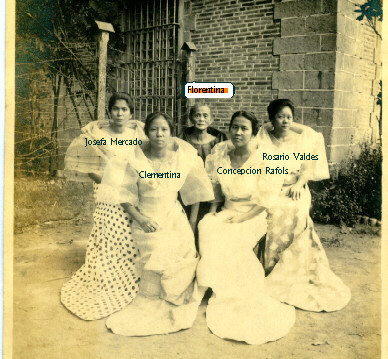
Florencia and her daughters-in-law

Pictured above are, from left to right, Josefa Mercado, wife of Javier; Clementina Elizalde, wife of Fernando; Conchita Rafols, wife of Bienvenido;  and Rosario Valdez, wife of Emilio.

Florencia held Sunday lunches in her house for her children and their families. She felt  a new wave of happiness.   She kept her children and grandchildren close to her at all times.  Eglantine, the second daughter of Fernando, was born in a bed in the house of Florencia.  This bed is now an antique carved over a hundred years ago by a Chinese bed maker.  Before Florencia’s house  in Sulipan was burned,  the bed was given to Clementina. It now stands in Clementina’s and Fernando’s ancestral home in San Luis, Pampanga.

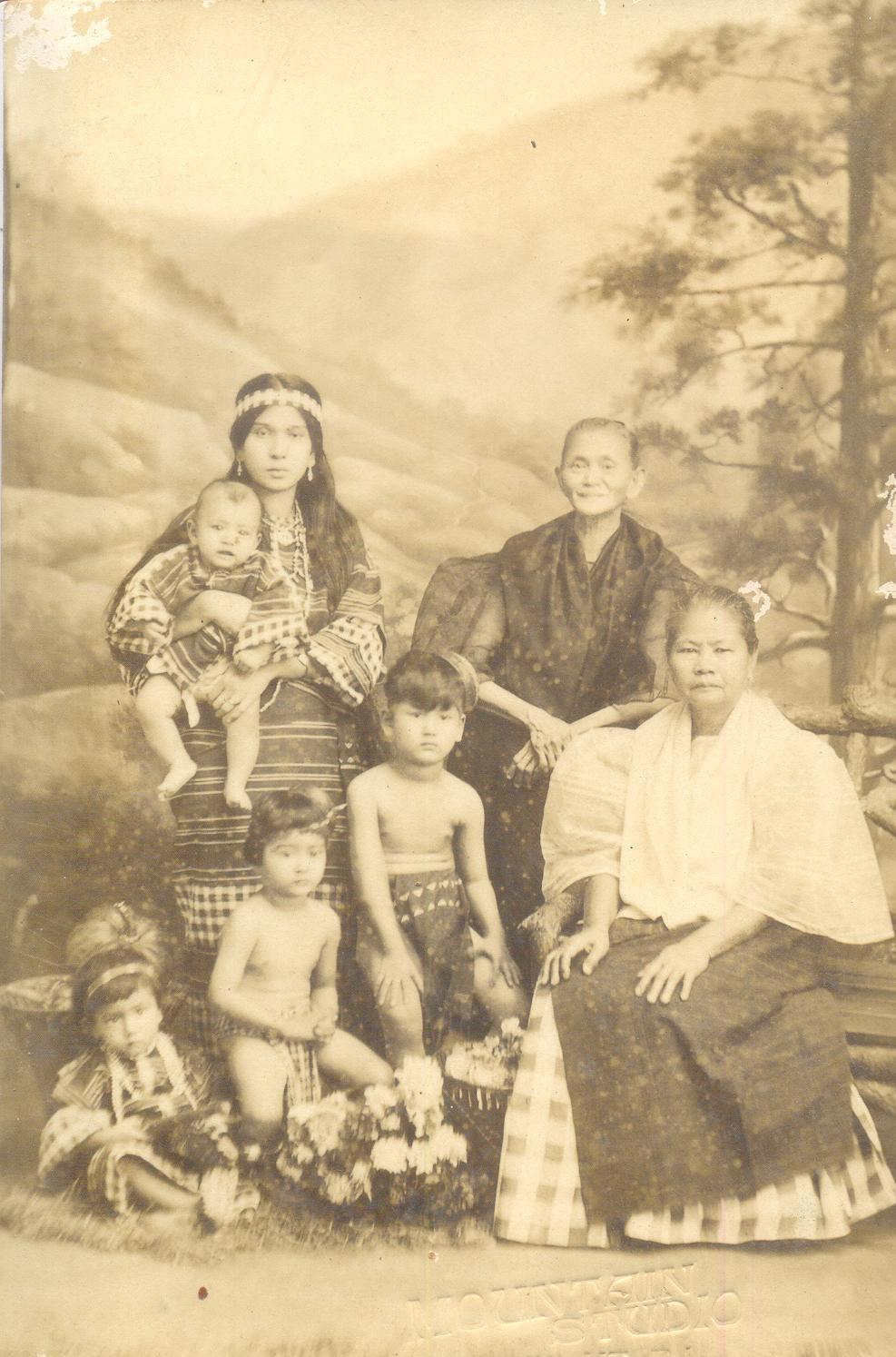
Florencia with a daughter-in-law and her grandchildren

HAVING FUN IN BAGUIO WITH GRANDCHILDREN

I will need an older generation to decipher who these people in the picture are with Florencia. Iit was the custom, then, that if you went to Baguio, you would go to a photographer to have a souvenir picture. You would be given costumes to wear.  Then you would give this picture to your relatives, for their files.  This was one such picture in my grandmother, Clementina’s, files.  I could only guess it was either Josefa Mercado and her children who were there, or Rosario Valdez and her children. It doesn’t look like Josefa Mercado because Josefa had thick hair.  But you can see the smile in Florencia’s face. She was enjoying being with her family.

Florencia died in November 6, 1925.   She was 65. She led a happy, complete, life..


[1]  Eva Gonzalez, on her write up of her memories of her father, UP Sixth President Bienvenido Gonzalez.

[2] Eglantine j. Gonzalez-Franco, Doña Clementina Elizalde-Gonzalez: A Tribute”. P.7.

            Mariquita bore six (6)  children with Friar Lopez.  They were three girls and three boys.

Soledad, the eldest child, bore a striking resemblance to her father.  Her childhood years were spent happily playing with her friends in the “convento” of the Baliuag Church and in the huge Gonzalez house.  She grew up to be a beautiful lady and she married Mariano Gonzales, a wealthy but deeply religious man.  She had seven (7) children:  Adelaida, Carlos, Caridad, Ceferino, Milagros,  Leon and Jacinto.

Jose, the second child, inherited the strong character of his mother.  He knew who he was and he did not allow anyone to forget it.  His favorite pastime as a child was to ride a gallopping horse inside the “convento” to the great consternation of the servants.  In his adulthood, he was used to undermining the Spanish curate and the military authorities.  He was notorious for his fiery temperament.  He married Francisca Carrillo, the daughter of another Friar, Father Arreola, and had six (6) children by her.  They were Ana, Maria, Filiberto, Carmelita, Luis, and Jose.

Joaquin, the third child, was a quiet boy who loved to read, play with animals, and make unusual toys.  He went to Spain where he became a doctor.  Upon his return home, he became involved in the struggle for independence.  He became a member of the Malolos Congress.  He married Florencia Sioco, and they had ten children:  Fernando, Jesus, Emilio, Augusto, Octavio, Virgilio, Javier, Bienvenido, Joaquin, and Fausto.  He settled in Sulipan, Apalit, Pampanga.

Rita, the fourth child, married a Spaniard, Jose Llora, and they had two children:  Ramon and Araceli.  They went to live in Spain.

Carmen, the fifth child, also bore a strong resemblance to her father.  She remained single.

Francisco, the sixth child, was a gregarious and playful little boy.  In his adolescence, like all boys, he became very fond of girls.  He married Maria Lloret, the daughter of a ship captain, when she was just 14 years old.  They had seven (7) children:  Ricardo, Paula, Estela, Sara, Cesar, Rafael, and Francisco.

Source:  This came from the earlier version of  the Family Tree Book  contributed by Renan Prado, Lita Estrada, Lilia Gonzalez, Tina Lesaca, Nena Franco.

I will write down all the dates of births, deaths and marriage for the Gonzalez Brothers and their Spouses.

Birth Death Marriage Age Married Age Died
7/22/1853 Dr. Joaquin
11/17/1860 Florencia Sioco
11/14/1881 Clementina
6/22/1884 Dr. Joaquin and Florencia J (31), F (24)
11/6/1884 Fernando
9/25/1885 Jesus Lope
9/27/1886 Emilio
1/2/1887 Isidora
11/8/1887 Augusto
2/23/1889 Octavio
7/18/1889 Marina Escaler
7/30/1890 Virgilio Rufino
12/1/1891  Javier Francisco
7/13/1892 Conchita Rafols
10/30/1893 Rosario Valdez
x/x/189x(3) Josefa Mercado Espiritu
3/22/1893 Bienvenido
4/23/1895 Joaquin Jorge
4/12/1896 Julia
5/30/1897 Fausto Felix
8/24/1899 Octavio 10
2/7/1899 Rosario Singson Veloso
9/21/1900 Dr. Joaquin 47
12/13/1903 Rosario Arnedo
5/10/1908 Luz
5/21/1909 Augusto n Marina A (21), M (19)
6/22/1910 Fernando n Clementina F (25), C (28)
3/12/1912 Jesus n Isidora (J (26), I (25)
10/18/1914 Javier n Josefa J (22) J (20)
3/21/1915 Pastora
10/8/1916 Emilio n Rosario E (30) R (23)
1/1/1917 Bienvenido n Conchita B (23) C (24)
5/1/1919 Virgilio n Rosario V (28), R (20)
11/5/1921 Joaquin and Julia J (26) J (25)
11/22/1922 Emilio 39
11/6/1925 Florencia Sioco 65
11/14/1926 Fausto n Amparo F (29) A (xx)
4/14/1928 Marina Escaler 38
2/20/1929 Virgilio Rufino 63
6/17/1929  Javier 37
8/15/1929 Amparo dela Rama 30
2/22/1930 Augusto n Rosario A (43), R (26)
4/7/1931 Josefa Mercado Espiritu approx 38
2/19/1937 Fernando 52
7/12/1939 Augusto 51
9/23/1941 Jesus Lope 55
9/15/1942 Fasuto n Pastora F (45) P (27)
5/14/1946 Julia 50
9/27/1947 Joaquin n Luz J (52) L (39)
10/15/1951 Fausto Felix 64
12/30/1953 Bienvenido 60
5/24/1964 Conchita Rafols 71
8/25/1968 Joaquin Jorge 73
3/29/1975 Isidora Espiritu 88
5/18/1977 Rosario Arnedo 73
6/9/1988 Luz 80
6/20/1991 Clementina 110
approx  2003 Pastora approx 88

The Brothers when they were Young

            THE GONZALEZ BROTHERS:  Their Life in Apalit

There are no stories on file regarding the romance of Dr. Joaquin and Florencia Sioco.  But looking at the record of their marriage, they registered their marriage on June 22, 1884, five months before their eldest son, Fernando, was born. Then every year,  one after another,  came Jesus, Emilio and Augusto.  The four children were well-behaved, and people branded them “apat  a matua”, meaning  “four matured/elder ones”. “Matua” connotes a feeling of respect.  “Balamu matua ya” means “ he acts matured beyond his years.”  When it is imminent that a baby is on the way, parents instill in their  elder children the responsibility of caring for this baby.    Of course, there can only be one “eldest child”. But in this family, the “apat a matua” were more subdued in comparison with the next batch.

Octavio came in 1889, but he was sickly and died after ten years.  He didn’t count.

After  a two-year hiatus, the next three children came in succession again. Virgilio came in 1890 quickly followed by Javier (1891) and then Bienvenido (1893). They were such a handful, they were labeled, “atlung demonius” – three devils.  This is always the fate of “middle children”.  The mother is already washed out from taking care of a big family, she doesn’t have time nor energy to give admonitions to the middle children as she did with the elder children.

In two years (1885), Joaquin II was born. Then another two years (1887), came Fausto.  These two were called “aduang bunso” or  the two youngest ones. They probably were overwhelmed by the ruckus caused by the “atlung demonius” they didn’t have the heart to add more problems  to their mother and their elders.

These were just labels to distinguish the grouping between the children.  We all know that children go through phases. When the “aduang bunsu” went into the teen phase, they did things as naughty as the earlier batch.

One such story was about Fausto, the youngest child.   During one baile, or party with dancing, he brought a pair of horses to the sala (living room). One of the horses was dressed in a frocked coat and wearing a hat, and the other one was dressed in a “Maria Clara”, meaning woman’s gown.  The guests were all shocked, but since this was a party, the shock turned into laughter.   The guests were all probably used to Fausto’s “cute” antics.

Between Fernando and Fausto, a period of thirteen (13) years, Florencia produced ten (10) children, all sons!

RUNNING THE APALIT HOUSE

Can you imagine the logistics of running a house with ten children? “Imang” Bets Rodriguez[1] remembers that the Gonzalez house was staffed with around twenty (20) maids.  Out of these, three (3) were mayordomas, three cooks, and four (4) men who did the gardening and cleaning of the cars.  They also had “balugas[2] who, at that time,  were not considered intelligent.

Florencia, the mother, supervised the kitchen very closely.  She would go to nearby Calumpit market, Bulacan, and buy everything in sacks.

VEHICLES

The family owned six (6) cars, several caruajes, some tiburins or Victorias, A Buick, and some calesins.  They were all parked in the garage.

THE APALIT HOUSE

The house of Florencia and Dr. Joaquin Gonzalez was built in 1883.  It was built in the floral style of the late nineteenth century, with a tile roof, tall windows with glass panes (instead of capiz used in the older houses), and a brick-decorated base.  Inside, curved arches in the Art Noveau style defined the different areas of the house.  Red bamboo lacquered panel walls provided an interesting touch.[3] It also had an entre suelo to provide more rooms for its inhabitants.

The house was bombed in 1945 by the Americans. They thought that the Japanese were hiding there.   It was part of the carpet bombing operation to weed out the Japanese from hiding.  There are no pictures of the Gonzalez Apalit house on account of the bombing.

HOUSE OF DIPLOMAS

Everyone who went to visit the Gonzalezes always noted  the Diplomas that were hanged prominently in the living room walls.  All the Gonzalez boys went to college and received diplomas. There were three doctors – Fernando, Jesus, and Virgilio;  three agriculturists – Bienvenido, Augusto and Joaquin; one pharmacist – Emilio; two lawyers – Fausto and Javier.

FAVORITE FOOD OF THE BOYS

Like any youngster, the Gonzalez boys loved potato chips.   They would be  peeled and cut round and thin, then soaked in salted water.  Then they would be dried before being deep-fried.


[1] Miss Beatriz “Imang Betz” Rodriguez is the eldest surviving member of the Rodriguez Clan of Bacolor, Pampanga, from which the Gonzalez-Sioco family of Sulipan, Apalit, Pampanga, are descended. She is a half-first cousin of Florencia Sioco y Rodriguez, since “Imang Betz” father, Felix Rodriguez y Bautista of Bacolor, was a younger half-brother of florencia’s mother, Matea Rodriguez y Tuason. The prefix “Ima” is given to an older woman as a sign of respect.

[2] Aetas.

[3] The description of the Apalit house was provided by Augusto “Toto” Gonzalez III, based on his researches on the subject.

JOSEF SIOCO

Josef Sioco

Josef  Sioco was originally from Bocaue, Bulacan.   His first wife was a lady surnamed “Carlos”. They had a daughter, Maria de la Paz Sioco y Carlos (+1897).  Maria married Joaquin Arnedo Cruz y Tanjutco (+1897).  (These + signs signify years when they died.)

Josef remarried. His second wife was Matea Rodriguez y Tuasan (+191_).  Matea was the second daughter of Olegario Rodriguez (+1874) by his first wife Escolastica Tuason (+1850).

Josef and Matea had three daughters:  Francisca (born before 1858), Sabina (1858-1950) and Florencia (1860-1925). Francisca died young.  Sabina married her Rodriguez first cousin Manuel Escaler y Rodriguez, of Balanga, Bataan.  Florencia married Dr. Joaquin Gonzalez of Baliwag, Bulacan.

After Josef Sioco’s death in 1864, Matea Rodriguez viuda de Sioco married Juan Arnedo Cruz y Tanjutco, the rich brother-in-law of her stepdaughter, Maria de la Paz Sioco de Arnedo.  Matea also outlived Juan.[1]

One of the characteristics of Josef Sioco was that he was a very good businessman.  He was able to accumulate a many pieces of landholdings all over Bulacan and Pampanga.  They called Josef, “Pepeng Daga”, which implied that he was like a rat, having small pockets of lands everywhere he went.

Some said that his lands reached  Tarlac, but there was no evidence of this from the Project of Partition[2] executed by the Gonzalez Brothers when Dr. Joaquin Gonzalez died.  The lands that could only have come from the inheritance of  Doña Florencia from her father Josef  Sioco , were in Magalang, Sulipan (Apalit), Capalangan (Apalit), Sucad (Apalit), San Vicente (Apalit),  Portrero (Bacolor), Cabalantian (Bacolor), Nabong (Calumpit), Tulauc  (San Simon) and  Sta. Monica ( San Simon).   If you map out these lands, you can see that it stretches from Apalit to Bacolor to Magalang.

The list looks impressive at first glance, but when Augusto, the most successful brother, tried to distribute the lands to his siblings after the death of their father Dr. Joaquin Gonzalez, he had difficulty raising the total value that each child would get to P4,000. From the Project of Partition, Augusto reached the “Fifth Revision”, and each child could only get P3,175 each. Eventually, he was able to distribute P4,000 each.

Later, these lands were  augmented by  direct purchases of lands or marriage to an heiress by the Brothers.

When Doña Florencia died in November 6, 1925 in Apalit, Pampanga, a subsequent Project of Partition was undertaken and finalized in 1927.  Unfortunately, this  author only has the Supplementary of the Partition, not the Main document. There was no mention of lands other than the Baliwag and San Simon lands, the Baliwag lands having come from Dr. Joaquin’s inheritance from Mariquita Gonzalez.


[1] Augusto Gonzalez III.  “Proposed Day Trip of the Gonzalez Doble Zeta Core Group”.  April 14, 2004.

[2] En El Interesado Del Finado Don Joaquin Gonzalez, “Proyecto De Particion De Bienes”. Causa Civil no. 254, Gobierno de las Islas Filipinas, Jusgado de Primera Instancia de Pampanga, Septimo Distrito Judicial.  July 1, 1915. 17pp.